


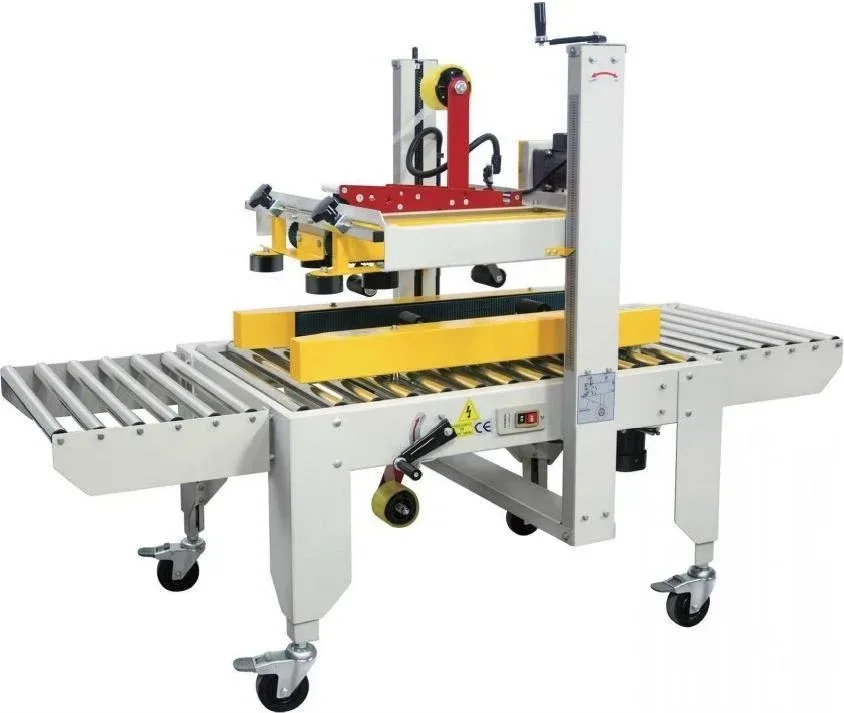
An empty shipping case and a filled shipping case may have exactly the same dimensions. They arrive at different stations. A **case erector** takes a flat case, opens it and prepares its bottom so it can receive the product. A **case sealer** closes a case at the sealing station, typically after it has been filled. To choose between them, stand where the work is delayed and look at what is arriving there.
What is a case erector?
A case erector starts with folded, flat cases. It separates a case, opens it square and folds its lower flaps. The configured bottom-closure station then closes the base. The resulting empty case proceeds to a packing bench or an automatic loading station.
The XD-KX450 is an example of shipping-carton preparation. Its catalogue lists a suitable tape width of 48–70 mm and a table height of 630 mm. For a line enquiry, confirm the drawing of the actual discharge and how the case is presented to the next station. A nominal table height is only one dimension of that interface.
What is a case sealer?
A case sealer works on an assembled shipping case. Some configurations expect the operator or an upstream station to close the top flaps. Others include flap folding. If your case travels straight from the packing station with the flaps still open, specify that condition before asking for a model.
In the Xunding range, the XD-FX5050 applies tape to assembled cartons. The XDZG5050 includes automatic top-flap folding for its specified range. Those are different scopes even though both machines apply tape.
How the stations differ
| Check | Case erector | Case sealer |
|---|---|---|
| Infeed state | Flat, folded shipping cases | Assembled shipping cases at the closure station |
| Main work | Open the case and prepare the bottom | Apply the specified closure, with flap folding if ordered |
| Output | Empty case ready for filling | Case with the agreed seal applied |
| What to test | Opening, squareness, bottom closure and empty-case handoff | Flap presentation, tape position, end overlap and seal acceptance |
| Adjacent operation | Loading the erected case | Labelling, weighing or onward handling, as required |
The packing step belongs between these two stations. If a line is quoted as a package, identify who provides product loading, conveyors and any accumulation space. Two machines with compatible carton ranges can still need an intermediate transfer.
Which station should you choose?
Choose an erector when operators lose time opening and preparing empty cases before filling. Test whether the empty case stays square at the packing point and can be loaded without turning it.
Choose a sealer when filled cartons already reach the end of the packing station, but closure is slowing dispatch or producing inconsistent seals. Bring a filled carton with its actual flap position. A flat sample alone cannot show how the top presents after loading.
If both steps are limiting, draw the three stations in order: erect → fill → seal. Mark the travel direction, conveyor heights, available space and state of the carton at each handoff. Include a short sequence of real cartons rather than one dimension range. The case-erector range and case-sealer range can then be checked against the same layout.
Send the layout and carton samples for a station-by-station review.