


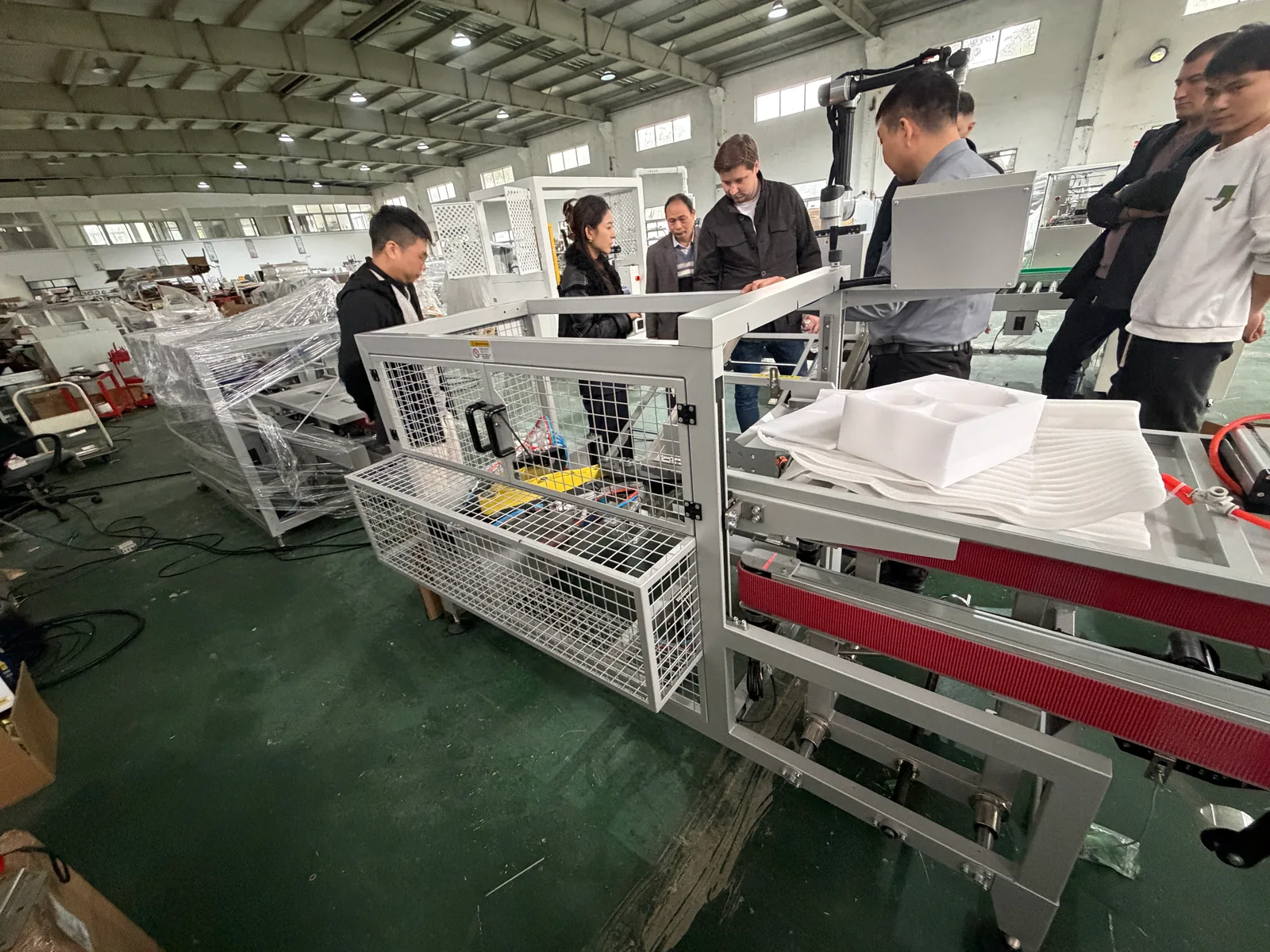
Most packaging lines are bought in pieces: a case erector from one supplier, a sealer from another, a robot cell from a third, and a layout drawing that nobody quite owns. The gaps only show up when the machines finally stand next to each other. This visit was arranged to find those gaps while they were still lines on paper.
Why one visit can cover more than one machine
A buyer comparing a case erector with a palletizing cell usually travels between warehouses. One supplier shows the erector, another shows the robot, and the connection between them — conveyor height, discharge direction, the space a person needs to reach the tape roll — belongs to neither demonstration.
Our workshop holds machines from several product ranges at once, at different stages of build: box forming and erecting machines under test, carton sealers being set, stretch wrappers and palletizing arms alongside them. The customer sees upstream and downstream equipment in the same afternoon instead of across three trips.
It is not a showroom. Some machines are guarded and running, others are wrapped and waiting for dispatch, and the floor is a working floor with cable runs and offcuts on it. What it does give is a continuous view — the flat blank going in at one end and the packed carton coming off at the other, within walking distance of each other.
The floor plan arrives before the machine does
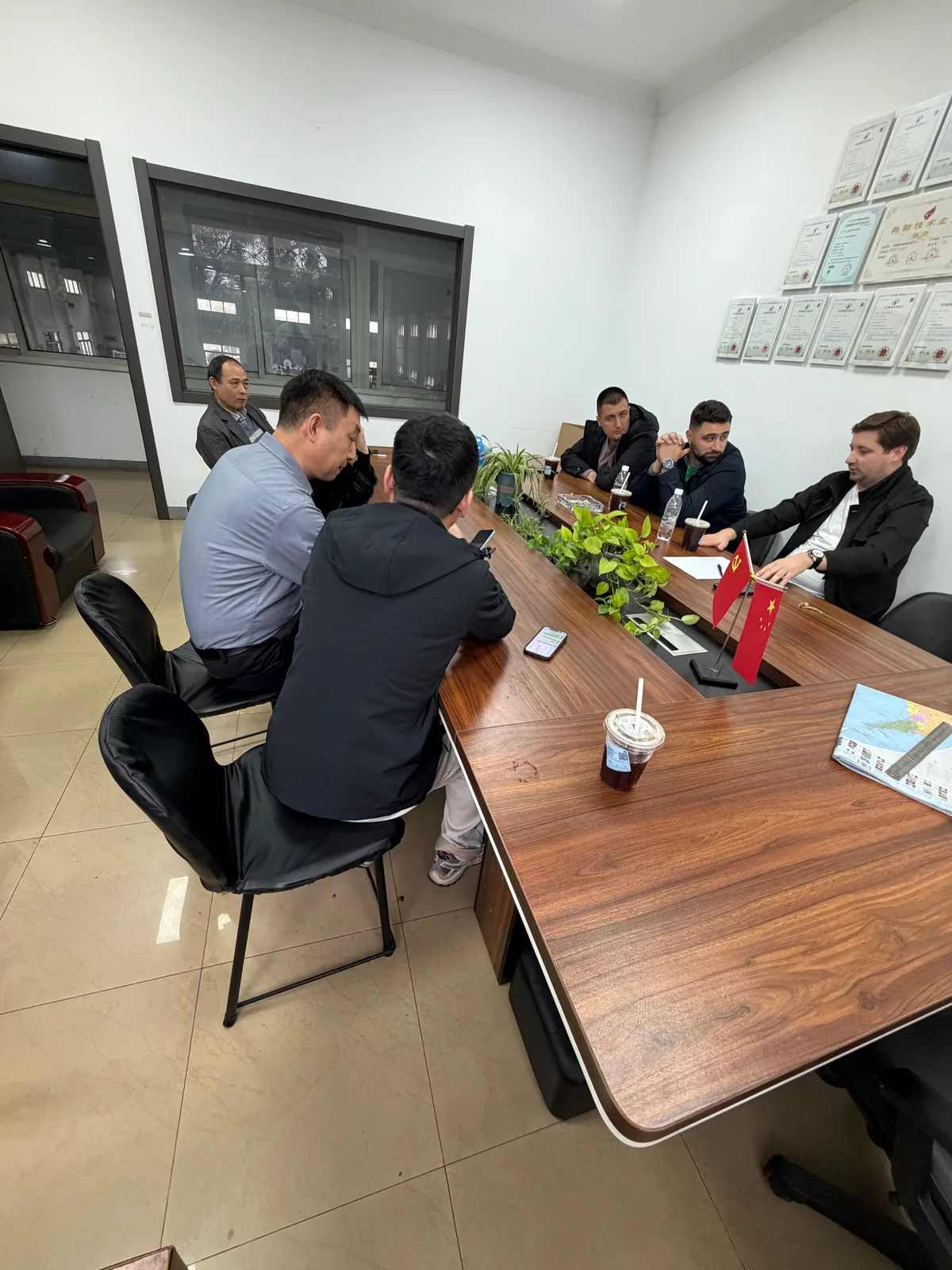
The visit began in the meeting room, not the workshop. The customer had brought a site plan: available floor length, column spacing, ceiling height, door openings and the direction trucks arrive from. Those measurements decide more about a layout than any catalogue page.
Machine dimensions are fixed by the model. The space around them is not. An erector needs blank magazine access on one side, a place for the operator to stand, clearance for the guard door to swing, and room to pull the machine forward for cleaning. A palletizing cell needs the robot base, the infeed conveyor, one full-pallet position and a second position for the next empty pallet.
On a drawing, those zones overlap easily. On the floor, they are exactly where a line stops working.
| Information | What it decides |
|---|---|
| Floor length and width available | How many conveyor sections and buffer positions will fit |
| Column positions and ceiling height | Where the machine can stand and how much clearance the guarding needs |
| Door openings and truck access | Whether the machine moves in assembled or in sections |
| Discharge direction and downstream equipment | Which way the carton leaves and at what height |
| Power supply and compressed air | The electrical configuration and pneumatic layout in the quotation |
Checking the drawing against the machine
Then the discussion moved to the workshop, and the drawing stopped being abstract. Standing beside an erector with a tape measure and a site plan is a different exercise from reading a dimension list. Magazine height, guard framing, the position of the control box and the reach of an operator all become visible at once.
This is the point where visitors usually change their mind about something. A machine that looked compact on a catalogue page turns out to need a longer infeed than expected, or the guard door opens into the walkway that had been planned for pallet traffic.
What changed during the visit
The customer had specified the site plan themselves, together with the machine envelope they could accept. With both on the table, the revisions were made during the visit rather than in a later exchange of drawings and emails.
The changes were practical ones:
- The length of the infeed and discharge sections, so the line fits between the column and the wall
- Which side the blank magazine is loaded from, following the route the operator already walks through the building
- The position of the guard access door, moved away from the aisle used by the forklift
- The robot base position and pallet locations in the palletizing cell, set against the height available under the roof trusses
- The height and orientation of the operator panel, so it can be read while standing at the magazine rather than from behind the machine
None of these is a line item on a price list. They are drawing changes, and they are cheapest before the frame is welded. Each one still has to be checked against the model’s documented size range and against the board, output and carton requirements of the order.
A layout is a set of constraints, not a preference. The machine can be adapted; the building usually cannot. The drawing stage is the only point where both can still move.
What the customer left with
By the end of the day there was a revised layout drawing and a short list of items still to confirm: the final power supply, the compressed air connection point, the carton sizes that would run most often, and whether the palletizing cell had to handle more than one pallet pattern.
That list matters as much as the drawing. A layout built on assumed carton sizes is a layout that gets revised again once the samples arrive.
Bringing your own cartons
Visitors who bring samples get more out of the day. A flat blank shows the board grade and crease pattern; an erected sample shows the corners the machine has to form. Printed cartons are useful too, because print position and board warp both change how a blank feeds through a magazine.
What helps most is bringing the sizes you actually run, not the ones that look neatest in a catalogue. If the line has to handle several carton sizes, list them all — the changeover requirement belongs in the layout, not in a later conversation.
Questions that came up during the visit
Can the layout still be changed after the order is placed?
It can, but every change after the frame is built costs more than the same change made on a drawing. The visit exists so that the expensive revisions happen early, while the machine is still a set of dimensions.
Do we need to bring cartons to a visit?
It is not required, but it changes the quality of the discussion. A flat blank and an erected sample let us check the magazine, the forming sequence and the discharge against your actual board rather than a similar one.
Arranging a visit
Visits are arranged in advance so that the relevant machines can be running and the people who work on layout drawings are on site. Tell us which equipment you want to see, and send the site plan beforehand if you have one — the first conversation can then start from your constraints instead of from a catalogue.
Compare the carton erecting machines shown during the visit
XD-KX450 automatic carton erecting machine
Review the collaborative palletizing systems behind the erector