


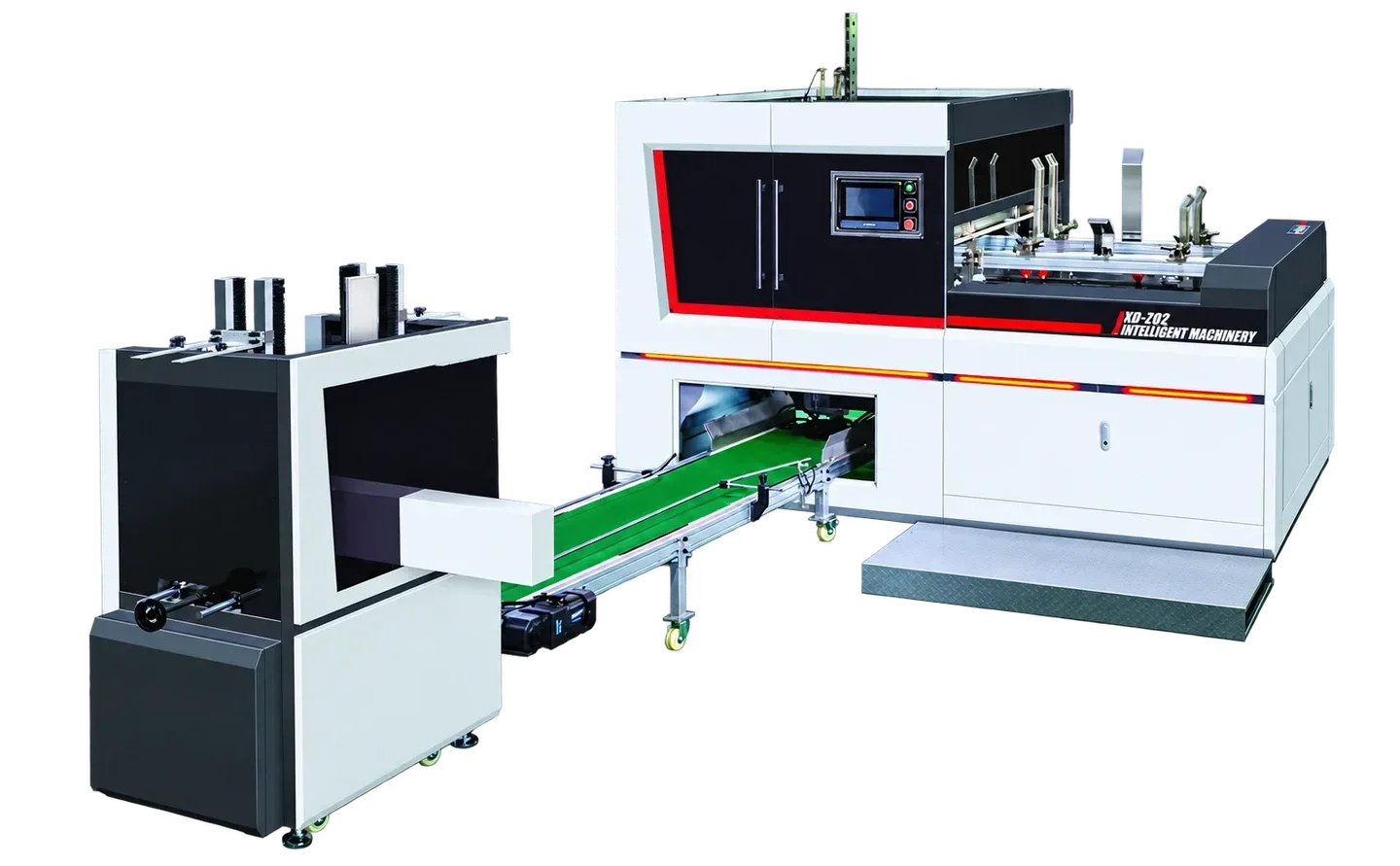
Bottom-suction feeding on a box forming machine draws the blank from beneath the stack, and the catalogue claims continuous replenishment for some entries rather than all. This page quotes the feeding wording model by model, including the six entries where the sentence is missing. The split runs by product family, and it decides where the operator stands during a shift, not how fast the machine forms.
Above the stack or below it
A stack of flat blanks has two ends, and a feeding arrangement has to choose one.
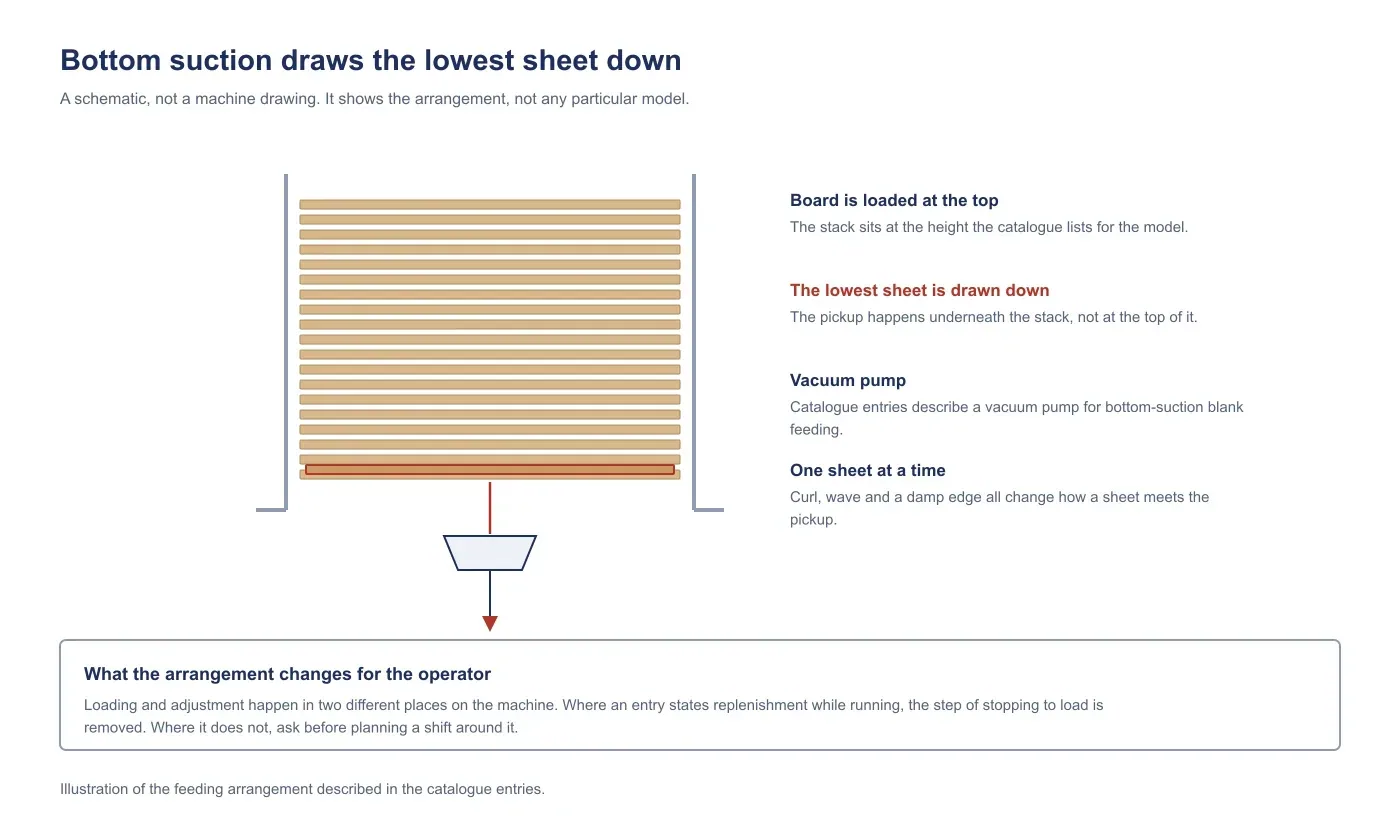
Bottom suction draws the lowest sheet down and away, so the stack rests above the pickup point. The catalogue states the arrangement inside the feeding line, and the exact wording splits three ways. The tray models say vacuum-suction feeding, the three-piece models say vacuum-pump bottom-suction feeding, and the mailer models say vacuum-pump bottom feeding.
That geometry has a practical consequence for the operator. Board is loaded at the top of the stack, which sits at the height the catalogue lists, and the pickup happens underneath it. Loading and adjustment are therefore two different places on the machine, and the guards and access around each belong in the layout discussion.
What the catalogue does not contain is a described top-feed arrangement. No entry on this site says a blank is taken from the top of the stack, so this page does not set up the two mechanisms as competing products.
The useful comparison sits inside the entries themselves. Some carry a sentence about replenishing the stack while the machine runs, and some describe feeding without that sentence. That difference is written down, which makes it checkable before an order rather than during a shift.
What the catalogue actually says
Feeding is described in short feature lines, and those lines are not written to a template.
| Model | Feeding wording in the catalogue | Replenishment while running | Cardboard stack height |
|---|---|---|---|
| XD-Z02 | Continuous feeding and folding: vacuum-suction feeding | Not stated | 300–500 mm |
| XD-Z03 | Bottom-suction feed to stacking | Not stated | 300–500 mm |
| XD-Z04 | Bottom-suction feeding: vacuum-pump bottom-suction | Stated | 300 mm |
| XD-Z05 | Bottom-suction feeding: vacuum-pump bottom-suction | Stated | 300 mm |
| XD-Z06 | Continuous feeding and folding: vacuum-suction feeding | Not stated | 1,200 mm |
| XD-Z07 | Continuous feeding and folding: vacuum-suction feeding | Not stated | 300–400 mm |
| XD-08 | Continuous feeding and folding: vacuum-suction feeding, and mechanical feed in the model list | Not stated | 300–500 mm |
| XD-09 | Vacuum-pump bottom feeding | Stated | 500 mm |
| XD-Z10 | Vacuum-pump bottom feeding | Stated | 500 mm |
| XD-Z11 | Vacuum-pump bottom feeding, repeated in the usage text | Stated | 500 mm |
| XD-Z12 | Vacuum-pump bottom feeding | Stated | 500 mm |
| XD-Z13 | Cycle feeding: circulating material-change function | Not stated | 800 mm |
| XD-Z14 | Continuous cycle feeding: circulating feed | Stated | 800 mm |
Read the third column as wording, not as capability.
Several entries carry the same sentence word for word, because the catalogue reuses the same feature list across models: the sentence appears wherever that list is used. Repetition across entries is not a separate test of each machine, and the table shows which models share the phrasing rather than pretending each was written alone.
Once the table is read by family, the pattern is plain. Every three-piece entry and every mailer entry carries a replenishment sentence. No entry on the fruit-tray line does, and that is the line most buyers ask about, because the fruit and vegetable box is the volume application. The shoe line splits, with the sentence on XD-Z14 and not on XD-Z13. Where the sentence is absent, the catalogue does not declare replenishment. That is not a statement that the machine cannot be replenished while it runs. It means the page gives no answer, and the answer has to be requested in writing for the model and configuration being quoted.
Two entries need reading twice for a different reason. XD-Z03 titles its row bottom-suction feed to stacking and describes feeding, forming, conveying and stacking as one sequence, without a separate statement about the stack. XD-Z13 titles its row cycle feeding and says only that a circulating material-change function supports the feeding process. Neither sentence says the machine has to stop for loading. Both leave the replenishment question open, and a buyer planning a shift around it should ask.
XD-08 carries both descriptions on this site. The model list gives it a mechanical cardboard feed system, while its catalogue sheet repeats the shared fruit-tray wording about vacuum-suction feeding. That is a question for the machine file, and it is worth settling before the layout is drawn.
Where two descriptions differ, the question is not which sentence reads better. It is which feeding arrangement the unit will be built with, and that answer belongs in the written configuration rather than in a comparison of catalogue pages.
What continuous replenishment changes
Where the catalogue carries the sentence, one step moves. Loading blanks stops being a reason to interrupt forming.
Everything else stays where it was. The forming sequence, the glue cycle and the discharge arrangement do not change because the stack can be topped up. Output per hour does not change either, unless the loading stop was the thing limiting the shift.
The size of the effect follows the stack. Catalogue stack heights run from 300 mm on XD-Z04 and XD-Z05 to 1,200 mm on XD-Z06. The tray models list 300–400 mm or 300–500 mm, the mailer models 500 mm, and XD-Z13 and XD-Z14 list 800 mm.
A stack that lasts most of a shift gains little from being refillable. A stack that empties twice a shift gains those two stops back, provided somebody is free to walk to the machine with board while it runs.
Replenishment also assumes the board is there to add. Someone has to move a bundle to the machine, open it and place the sheets square on the stack. If that task is nobody's job, the sentence on the catalogue page describes a possibility rather than a routine.
That is the honest version of the benefit. It is a scheduling change at the infeed, not a change in what the machine can do.
What it does not solve
Board that will not lie flat. Curl, wave and a damp edge all change how a sheet meets the pickup. A vacuum arrangement lifts what it can reach, and a sheet lifted at one corner may not seal at all.
Cut-outs under the pickup. Ventilation slots, hand holes and corner cut-outs are part of the blank. A pickup point over an opening has less board to hold, which is a tooling position question rather than a feeding-mode question.
Board outside the listed thickness range. The catalogue gives a range per model, such as 1.5–5 mm on XD-Z03, 1.5–7 mm on XD-Z06 and 1.5–6 mm on XD-Z07. A board outside that band belongs in a different conversation about the configuration.
Dust and trim on the stack edge. Board dust between sheets reduces the hold a cup can establish, and no feeding arrangement removes the need to keep the stack clean.
The stack height limit itself. A taller stack is not automatically better. The catalogue value is the height to plan around, and it differs by model for reasons that belong to the machine file.
Four of those five belong to the board or the blank rather than to the machine. That is worth saying plainly, because a feeding problem is often bought as a machine problem. If the board curls in the store, arrives damp, or varies between deliveries, the first conversation is with the board supplier and the first test uses production board.
What to record at a trial
A feeding trial answers questions that a photograph of a running machine cannot.
- Which model, and which feeding wording its entry carries.
- The board used: thickness, supplier, and whether the sheets were flat when loaded.
- The stack height loaded, and what happened in the last 50 mm of it.
- Whether blanks separated one at a time, and where the first hesitation appeared.
- How long a full stack lasted at the agreed output, and who replenished it.
- What the operator had to reach, and whether the guards allowed it.
Keep the record with the blank drawing and the board sample. The sample-trial checklist lists the other fields worth agreeing, and the two documents belong in the same project file.
The last 50 mm matters more than the first 50. A stack that feeds cleanly when full and hesitates when nearly empty is telling you something about the board and the pickup position. That is also the condition an operator meets at the end of every stack.
If two models are being compared, give them the same board, the same stack height and the same box. A feeding comparison run on different board answers a different question.
Photograph the stack before loading and after the last sheet. Those two frames show the board condition and the residue at the bottom of the stack, which is the evidence a supplier needs if a pickup problem appears later.
Final thoughts
Feeding wording on a catalogue page answers a narrow question: where the blank comes from, and whether the stack can be topped up while the machine runs.
On this site the replenishment sentence sits on the three-piece entries and the mailer entries. The fruit-tray entries do not carry it, and those are the models most buyers arrive asking about. Read that as a gap in the declaration rather than a limitation of the machine, and close it with one written answer per model before the layout is drawn.
The narrowness is the point. Two machines carrying the same sentence can still differ in stack height, in board range and in what the operator has to do. Two machines carrying different sentences may both feed well on your board.
Ask for the wording, then ask what it means for your blank, your board and the way your shift is staffed. The XD-Z03 model page shows how the feeding line sits with the rest of a forming specification, and it is a reasonable place to start comparing.
A feeding arrangement is easy to describe and hard to compare, because the sentence that matters is short: replenished while running, or not.
Send your blank drawing, board sample and shift pattern to Xunding for a feeding check
Frequently asked questions
Is bottom-suction feeding the same as vacuum feeding?
Mostly, in the catalogue's wording. Vacuum-suction, vacuum-pump bottom-suction and vacuum-pump bottom feeding all describe drawing the lowest sheet from beneath the stack. The entries use different phrases for the same family of arrangement, so compare the full sentence rather than the label.
Can blanks be added while the machine is running on every model?
No. The sentence appears on the three-piece models, XD-Z04 and XD-Z05, on the mailer models, XD-09, XD-Z10, XD-Z11 and XD-Z12, and on XD-Z14. It is missing from XD-Z02, XD-Z03, XD-Z06, XD-Z07, XD-08 and XD-Z13. Where the sentence is missing, ask before planning a shift around it, and get the answer written into the configuration.
Does stack height change how the sheet is picked up?
The catalogue lists a stack height per model, from 300 mm to 1,200 mm, and that is the figure to plan around. A taller stack changes how long the machine runs between refills rather than how the sheet separates from the one below it.
What board problems stop a vacuum pickup?
Curl, waviness, a damp edge, dust between sheets, and a pickup point over a cut-out all reduce the hold. Use production board in the trial, loaded the way it arrives at the plant, rather than a flat sample kept aside for the demonstration.
Does the stack height limit how long a shift can run?
It sets how long the machine runs between refills, and the catalogue lists a value per model. Replenishment during running changes who refills and when, not how many sheets the stack can hold. Plan the shift around the listed height, then confirm the replenishment arrangement for your model.