


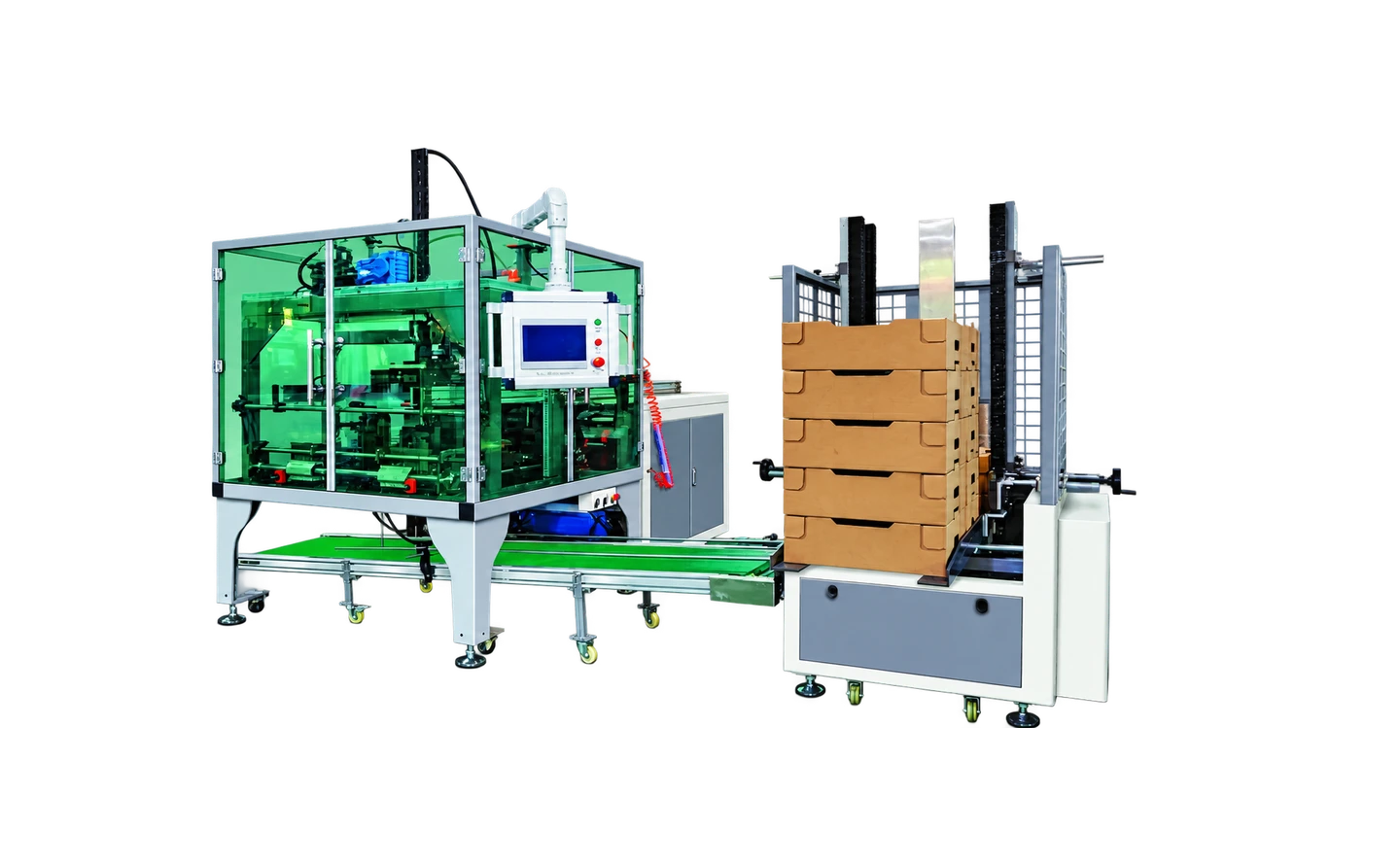
Choose a carton box folding machine around the box it needs to produce. Xunding can identify the machine model from a clear photograph of the formed box plus a flat blank photograph or die-cut drawing. Add daily output and dimensions to refine the recommendation. The comparison below helps you review catalogue candidates before discussing the configuration for your own box.
What do you mean by a folding carton?
A carton folding machine can refer to several types of equipment. A printer may use the term for a folder-gluer that makes folded, glued cartons from die-cut blanks. A fruit packer may need an open corrugated tray formed with upright walls. A warehouse may be asking about erecting a shipping carton.
Show the finished box and the flat material entering the machine. The folds, corners, joints and desired outlet condition identify the production task more clearly than a machine name alone. A formed photograph and a complete flat view let Xunding begin the model selection without asking you to choose a catalogue reference first.
See the two box views and dimensions needed for model selection
One blank or separate pieces?
Check how many parts make up the box. A single-blank fruit tray and a three-piece tray follow different forming processes. In the Xunding catalogue, XD-Z03 is a multifunctional box folding model; XD-Z04 is three-piece fruit box forming equipment. Neither should be selected simply because its size range looks close.
Mailer boxes and hinged-lid boxes add further questions. Where are the locking tabs, glued corners and lid folds? If you want to run several designs, send each blank. A size adjustment does not automatically mean the machine can handle a different structure.
Review equipment for three-piece box structures
Compare fruit tray catalogue candidates
For a fruit tray enquiry, the following model-specific ranges provide a first comparison. The values are from the 2025 Xunding catalogue and the corresponding model pages. Speed, board thickness and finished-box dimensions describe different conditions; all must be reviewed with the actual blank.
Similar figures do not make two machines interchangeable. For example, XD-Z02 and XD-Z03 list the same speed and finished-box ranges. Their feeding and forming arrangements, configuration and suitability still need review against your box. Do not select either model on these figures alone.
| Model / source page | Catalogue output (boxes/hour) | Board thickness | Finished-box L / W / H |
|---|---|---|---|
| XD-Z02 · p. 3 | 1,200–3,000 | 1.5–5 mm | 180–650 mm / 180–470 mm / 60–230 mm |
| XD-Z03 · p. 4 | 1,200–3,000 | 1.5–5 mm | 180–650 mm / 180–470 mm / 60–230 mm |
| XD-Z06 · p. 7 | 1,500–1,800 | 1.5–7 mm | 220–680 mm / 220–680 mm / 70–250 mm |
| XD-Z07 · p. 8 | 1,200–1,800 | 1.5–6 mm | 330–600 mm / 240–600 mm / 90–250 mm |
| XD-08 · p. 9 | 2,000–3,500 | 1.5–7 mm | 220–680 mm / 220–680 mm / 100–250 mm |
Check the board and finished-box dimensions
Specify the board type and actual thickness, including any coating. Measure the finished box in millimetres and label length, width and height on the drawing. Say whether the dimensions are internal or external and keep the flat blank size separate. Give the supplier a physical sample where corners or folds are difficult to explain.
The catalogue lists XD-Z03 for 1.5–5 mm board, while XD-09 and XD-Z13 list 1.5–3 mm. These are model-specific starting points. They do not establish suitability for every material within that thickness range. A size range also does not mean that every combination of dimensions or every corner structure can be produced.
Use daily output to discuss the required configuration
Give the boxes per day you need, available working hours, shifts and any seasonal peak. Include the mix of sizes and expected changeovers. A daily target over a short operating window needs a different capacity discussion from the same target spread across more hours.
Daily boxes divided by available production hours gives a planning average, but the proposal also needs to consider feeding, replenishment, size changes and acceptable output. Catalogue speed is a reference for a model, not a guarantee of finished-box production throughout your shift.
What should be automatic?
An automatic carton folding machine enquiry should also explain the work around forming. Do you need automatic blank feeding, gluing, conveying or stacking? How will boxes leave the equipment and reach the packing station? Identify which steps currently need an operator.
For a configured production line, review the included equipment, layout and upstream/downstream connections. Ask which functions are standard for the quoted setup and which are options. The machine model, your box and the written configuration should describe the same production task.
Confirm the candidate with your sample
Once the model and proposed configuration have been discussed, agree the material, finished-box checks and output record for a sample trial. Keep the drawing revision and actual trial conditions with the result. Include size changes that matter to your production.
Send the formed box, flat photograph or die-cut drawing, finished dimensions and daily requirement to Xunding. These materials move the discussion from a broad machine category to a model and configuration suited to the job you need to run.
Catalogue models to discuss
These models are starting points for an enquiry. Confirm the configuration against your blank and sample.
- XD-Z03 · Multifunctional box folding machine
An automatic fruit-box forming setup combining bottom-suction feeding, folding knives, gluing, conveying and stacking.
- XD-Z02 · Multifunctional box folding machine
Automatic forming for inward-folding fruit and vegetable boxes, with feeding, gluing, folding and stacking in one process.
- XD-Z06 · Automatic fruit box forming machine
Fruit and vegetable box forming with vacuum feeding, PLC control and automatic stacking. The catalogue lists cardboard up to 7 mm thick.
- XD-Z07 · Automatic fruit box forming machine
Automatic feeding, gluing and folding for fruit and vegetable boxes, with a catalogue board-thickness range of 1.5–6 mm.
- XD-08 · Automatic fruit box making machine
Automatic cardboard fruit-box forming with a catalogue speed range of 2,000–3,500 boxes per hour and board thickness up to 7 mm.
- XD-Z04 · Three-piece fruit box forming machine
Forms three-piece fruit and vegetable boxes from separate cardboard parts, with automatic feeding and touchscreen mould settings.
- XD-09 · Automatic mailer box forming machine
Automatic forming for folding mailer boxes, described as aircraft boxes in the catalogue, for clothing, crafts, electronics and general product packaging.
- XD-Z13 · Automatic hinged-lid shoe box machine
Forms cardboard boxes with an integrated hinged lid for footwear, clothing and general product packaging, using hot-melt glue and automatic folding.