


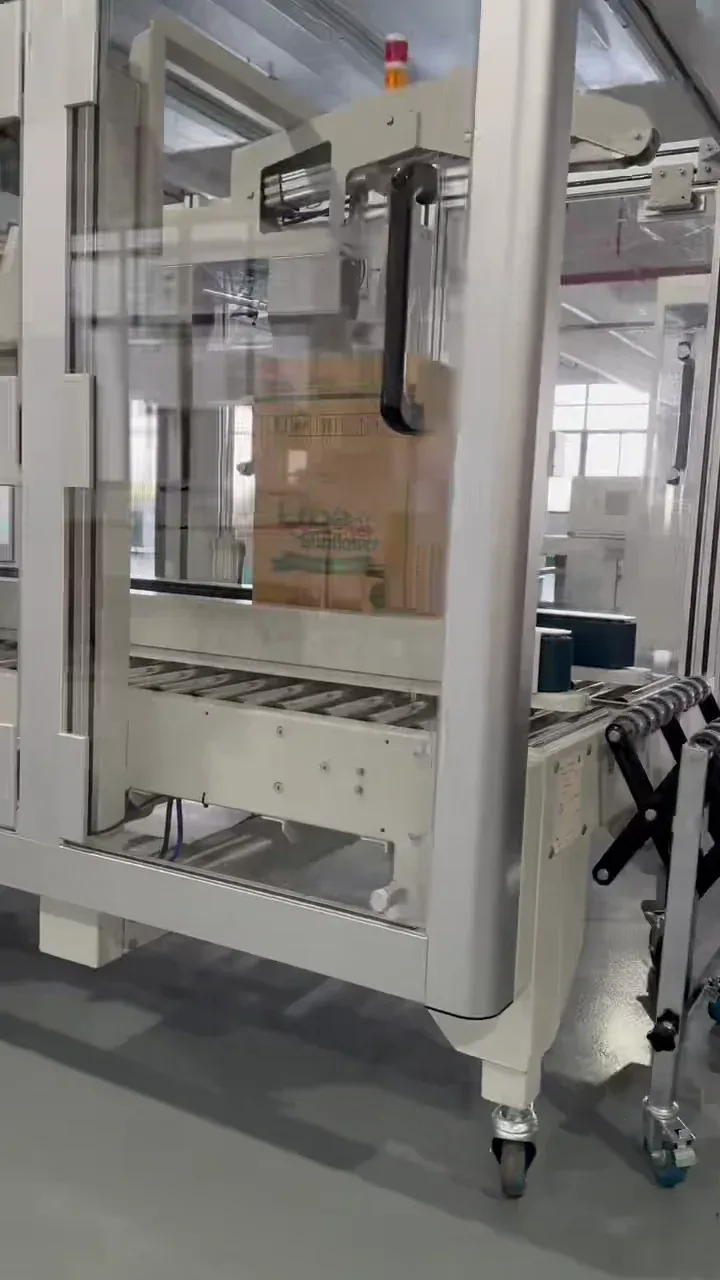
A co-packer may run one carton size for an entire order on Monday and receive four different cartons on the same conveyor on Tuesday. Those jobs call for different trials. Before comparing case sealers, take one real order sequence from your scheduling system and put it on the trial sheet. The sequence tells you more about the infeed requirement than a combined list of minimum and maximum dimensions.
Main sealing arrangements for contract packaging
Fixed setting between orders
A set of guides and tape heads stays at one setting while an order runs. The next size is introduced after the operator completes a planned adjustment. This arrangement is worth comparing where orders are kept together and the team can predict when the line will change over.
Size adjustment on successive cases
If different lengths, widths or heights arrive in the same stream, discuss a size-sensing configuration and ask how it responds to the actual sequence. Ask whether there must be space between cases and whether the flap condition changes between products. The supplier should name the offered configuration. Automatic flap folding and automatic size adjustment are separate specifications.
Extra sealing operations
A new customer may require reinforced edge taping or present a carton with a side seam. Identify these as separate jobs in the order file. They change which surfaces the machine must reach. The ordinary top and bottom centre seam is one operation, while a corner-taping station is another.
Where each arrangement fits
| Order pattern | What to put through the trial | Record before releasing an order |
|---|---|---|
| Long run, one size | A representative stretch of the usual order | Accepted cases, interruptions and seal appearance |
| Short batches using the same carton family | The final cases of one order followed by the first cases of the next | Time to last accepted old case and first accepted new case |
| Adjacent cases of different sizes | The actual size order, including small–large–small transitions | Any manual adjustment, stop, missed fold or rejected seal |
| Customer-specific closure | The same carton with the specified tape and seam pattern | Which station performs each part of the agreed seal |
A trial made up of one neat sample from each customer leaves out the awkward part of co-packing: one order ending as another begins. Use labels or a run sheet to identify samples at discharge. Agree who records rework and whether a carton can be counted if it had to be resealed away from the line.
How should you choose?
Start with the contract you would find hardest to run. If the line can be grouped by size, compare the observed adjustment time against the time the business can allow between orders. If order assembly dictates mixed infeed, watch the transitions instead. A machine that handles each size in a separate batch may still be unsuitable for that sequence.
Send the carton order, flap state and closure pattern alongside the dimensions. Review the mixed-size carton application and sealing range for configuration options. Ask for a quotation that states the order pattern used for acceptance, so later order changes can be evaluated against a recorded baseline.