


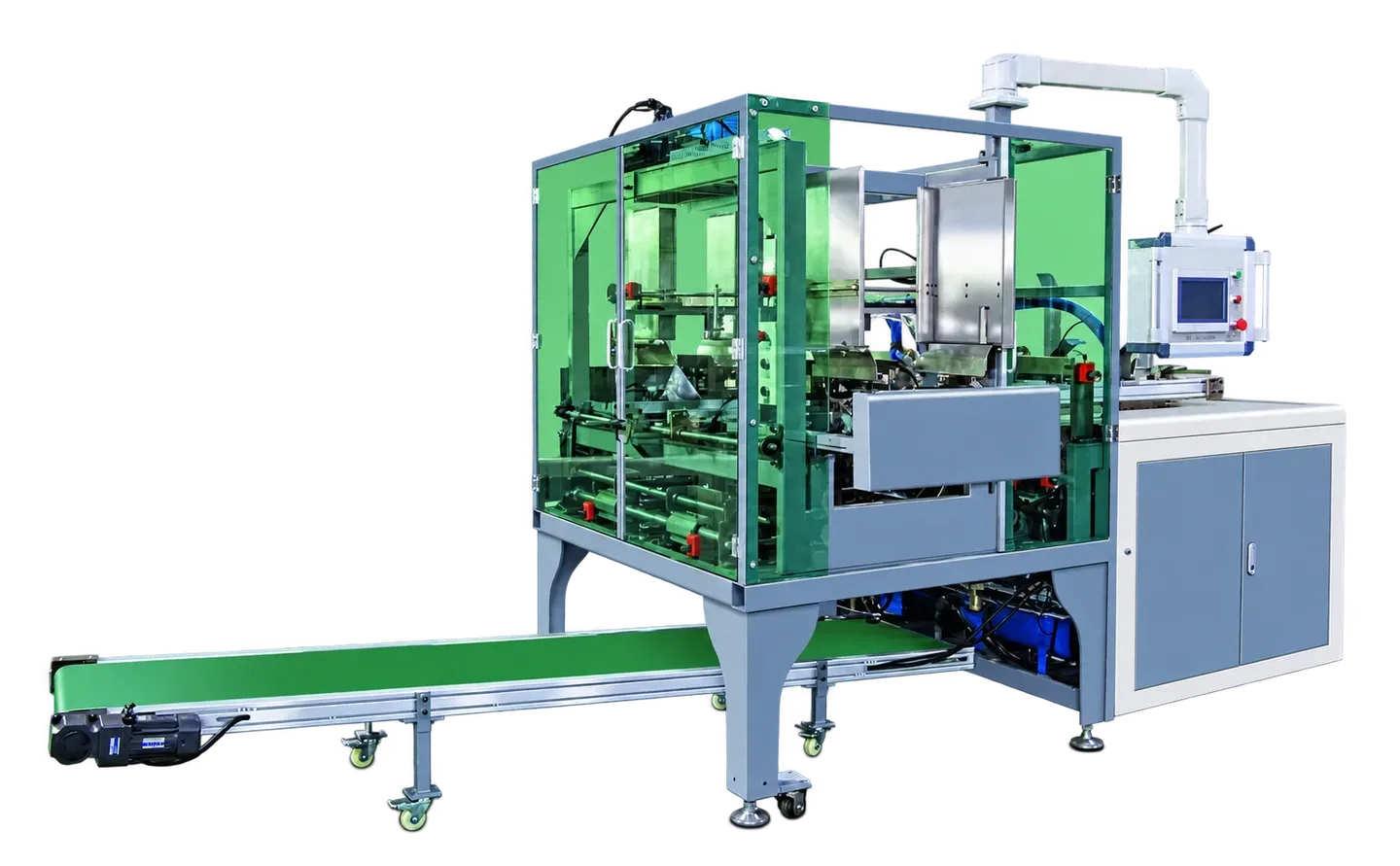
Compressed air consumption on a box forming machine is a flow figure in litres per minute, and the pressure gauge on your wall cannot show it. This page separates the two numbers using the values Xunding publishes for its own configurations. What follows is a short list of questions for your air supplier, not a compressor size.
Pressure and flow are two numbers, and the gauge reads one
A pressure gauge reports the force in the line where it is fitted. Flow reports how much air passes a point in a minute.
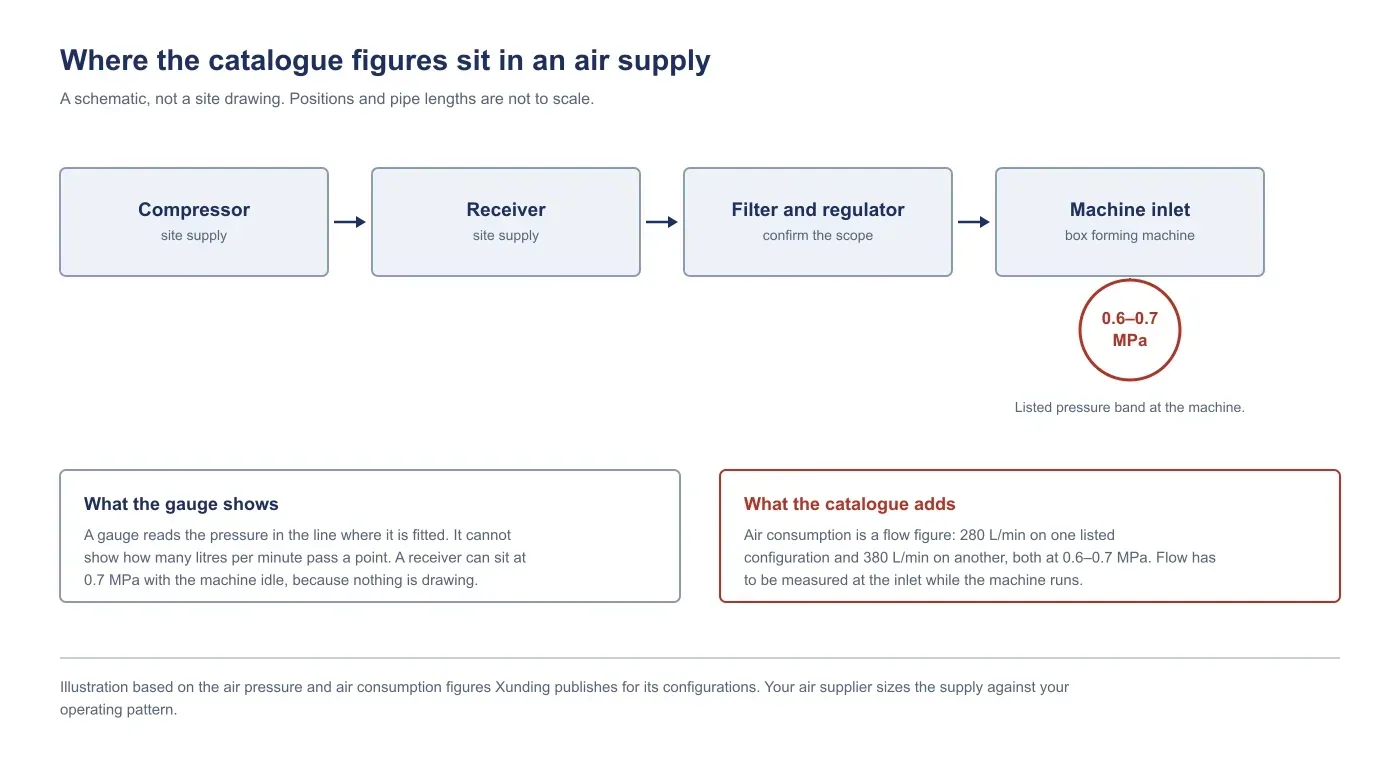
A receiver can sit at 0.7 MPa with the machine idle and still be unable to feed a running machine. The gauge holds its reading because nothing is drawing. Once the machine starts cycling, the same gauge can fall away.
The catalogue gives both numbers for each machine. Air pressure is listed as 0.6–0.7 MPa, a band rather than a single value. Air consumption is listed as a figure in litres per minute, such as 380 L/min.
Only one of those can be read on a gauge you already own. The other needs a flow measurement at the machine inlet, taken while the machine runs, which is why a gauge reading settles nothing on its own.
A gauge fitted upstream also shows what the compressor maintains, not what arrives at the machine. Pipe length, filters and regulators sit between the two points, and each of them costs pressure the gauge does not show.
The 0.6–0.7 MPa band is worth reading as a band. It describes a working range at the machine, not a target to beat. A supply that sits at the top of the band while idle is not thereby proven.
Same pressure, two flows
Two published configurations make the point more clearly than any explanation. Both are Xunding values for the configurations described on this site.
| Item | Deep-box configuration | Siemens-based tray configuration |
|---|---|---|
| Air pressure | 0.6–0.7 MPa | 0.6–0.7 MPa |
| Compressed air consumption | 280 L/min | 380 L/min |
| Configuration output range | 20–30 boxes/min | 20–50 boxes/min |
| Cardboard thickness | 1.5–3 mm | 2.5–7 mm |
| Finished box height | 150–350 mm | 50–250 mm |
The pressure row is identical. The flow row differs by 100 litres per minute, which is the whole question in one line.
The higher flow belongs to the configuration that also lists the higher output range. That does not show that flow sets output. The two configurations differ in board thickness, box height and control package as well, so the pair is not a controlled comparison.
The catalogue follows a similar pattern without matching it exactly. The fruit tray entries list 380 L/min and the mailer entries list 280 L/min where a figure is given. XD-Z05 and XD-Z12 give a project-specific configuration instead of a figure, and the XD-Z11 technical table carries no air row at all.
That spread is the reason to read the figure per machine. A number copied from a neighbouring model is a number about a different machine.
The honest comparison uses the specification sheet, line by line: pressure, flow, board range, box range, glue tank and control package. Read together, those lines say whether two configurations are near neighbours or different machines sharing a model family name.
The models behind those numbers sit in the fruit tray forming range, and each model page repeats its own sheet.
The catalogue does not publish air consumption per box, and this page does not derive one. Dividing a flow figure by an output range would produce a number nobody measured, on a machine whose output depends on the box and the board.
Where the air goes, in the catalogue's own terms
The catalogue gives one total per machine and does not split it by function.
The entries do name the equipment that total serves. A hot-melt glue unit is listed with an 8 L or 10 L tank. A vacuum pump is listed for bottom-suction blank feeding. Air-supply detection is listed in the control system.
No entry states how much of the total belongs to each of those. Any apportionment, such as a share for gluing and a share for pickup, would be an invention, so this page does not offer one.
Air-supply detection is worth more attention than it usually gets. The three-piece feature list describes a motion controller coordinating photoelectric tracking, air-supply detection and the touchscreen interface. The machine therefore watches its own supply.
That changes how a shortfall presents itself. It is a machine condition the control system detects, rather than something the operator infers later from boxes arriving slowly or blanks failing to lift. A supply problem is reported as a supply problem, not absorbed quietly into the run.
The detection also tells you where to look first. If the machine reports a supply condition, the question is what the inlet is delivering while it runs, not whether the compressor is switched on.
One total is still the right unit for a supply conversation. Your air supplier sizes a system against what the machine takes at its inlet, not against a list of internal functions. The total is useful precisely because it is the number the machine presents to the line.
When the catalogue gives no number
Three situations appear in the same catalogue: a stated figure, a project-specific configuration, and an entry with no air row.
An entry with no air row is not a machine that uses no air. It is an incomplete table, and the requirement belongs in the written configuration before the order is placed.
A project-specific line cannot have a fixed figure before its layout exists, because the station count and the arrangement belong to the project. The question changes from what the model needs to what the proposed line needs.
Five items are worth asking for in writing:
- The requirement sheet for the exact configuration, not for the model family.
- Whether the figure covers one machine or a complete line.
- The connection point, fitting size and pressure required at the machine inlet, taken from the layout drawing.
- Whether a regulator and filter belong to the machine scope or to the site supply.
- The air quality expectation, including drying and filtration.
Two documents carry those answers: the specification sheet and the layout drawing. The installation guidance on this site adds a third check. The nameplate on the machine itself is what the unit was built to, and utilities should not be estimated from past machines or from memory. The rest of the pre-delivery list sits in the installation conditions to confirm before the machine ships.
A project-specific figure also arrives late by nature. Ask when it will be issued, and make the answer a condition of the layout approval rather than a question raised at commissioning.
What to put on paper before the machine ships
Power and air are usually recorded in the same conversation, and they fail in the same way. The buyer writes down one number per utility and later discovers there were two.
The site's utilities list separates them. Power has voltage, phase and frequency, plus the supply circuit and who provides the cable and isolator. Air has the pressure and flow, the quality expectation, and the fittings on the layout drawing.
Write pressure and flow as two separate lines on the same sheet. They answer two different questions, and a sheet with one of them is a sheet that will be filled in from memory later.
Margin is the part this page leaves to your air supplier. Their answer depends on compressor duty, receiver volume, pipe diameter, run length, other machines on the same ring main, and how often your line starts and stops. A margin figure offered here would be a guess dressed as advice. Give them the machine's flow requirement and your operating pattern, and ask for the figure in writing.
On delivery day the sequence is short. Read the nameplate, compare it with the sheet already filled in, then record what the site delivers at the machine inlet while the machine runs. That record becomes the baseline for every later air question on that line.
Final thoughts
Two numbers decide whether the air supply suits a box forming machine, and only one of them appears on the gauge. Pressure is the easier half, and it is the half that gets quoted in conversation.
Read the flow figure for the exact configuration, ask what the total covers, and put both numbers on the installation sheet beside the layout drawing. That is the method, and it takes less time than correcting an air problem after commissioning.
The number to carry into the order is one line: flow at the machine inlet, written beside the pressure band and the connection point on the drawing.
Send your configuration, box range and site air details to Xunding for a requirement check
Frequently asked questions
My gauge reads 0.7 MPa but the machine still reports an air problem. Why?
Pressure at the gauge is not flow at the machine. A line can hold 0.7 MPa while the compressor and receiver cannot deliver the litres per minute the machine draws. Check the flow figure for your configuration, then have your air supplier measure at the machine inlet while it runs.
Can one compressor serve two box forming machines?
Add the flow figures from both specification sheets, then ask your air supplier to confirm the supply against that total and your operating pattern. The catalogue gives consumption per machine, not a shared-supply allowance, and this page publishes no diversity factor.
Why do two models with the same pressure need different air?
The pressure band is a requirement rather than a measure of demand. Consumption follows the configuration: board range, glue unit, vacuum pump and control package. Xunding lists 280 L/min for one configuration and 380 L/min for another, both at 0.6–0.7 MPa.
What does a project-specific configuration mean for air?
It means no single figure applies until the line layout and station count are fixed. Ask for the requirement with the layout drawing, and treat the number as belonging to that configuration rather than to the model name, and ask when it will be issued.
Does air quality belong in the same conversation?
Yes. The utilities list includes drying and filtration, and whether the machine carries its own regulator. Moisture and particulate travel to the valves and the vacuum circuit, so the quality expectation belongs on the same sheet as the pressure and the flow.