


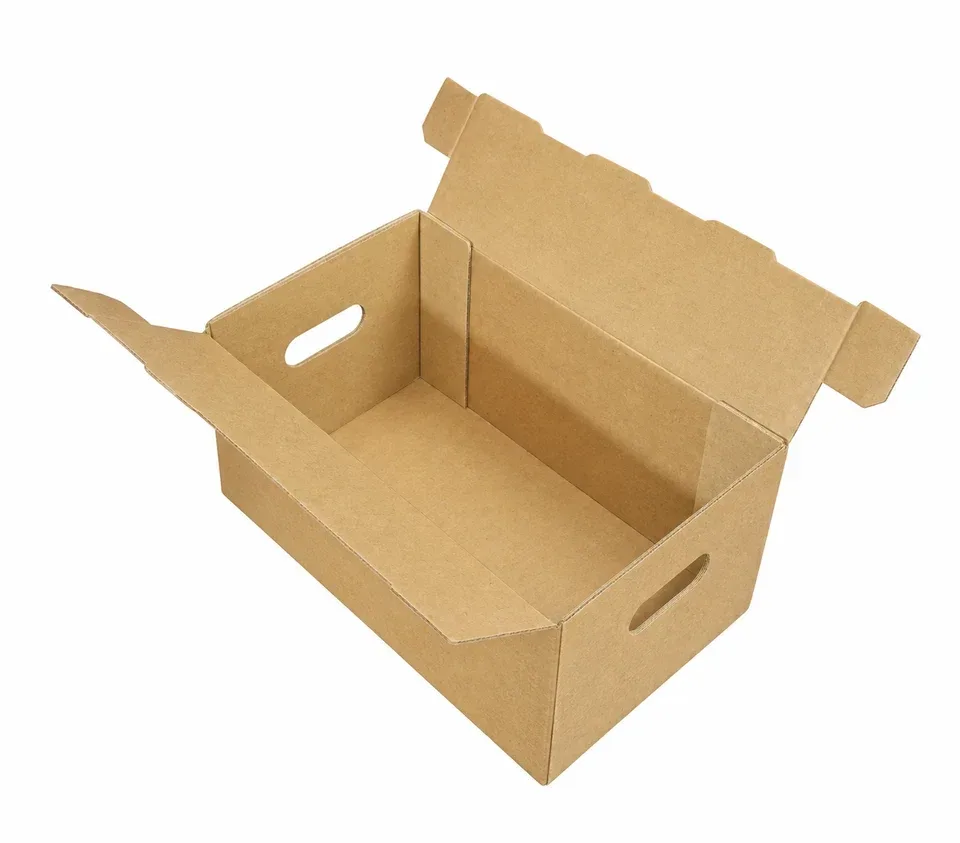
The hinged lid vs lid and base box question is settled by one point, whether the lid stays attached to the base or arrives as a separate part. That single difference decides the blank count, the forming sequence and, in the Xunding range, which model is quoted. This article compares the two structures against the catalogue entries, sets out what each drawing has to show, and marks the point where a supplier has to confirm rather than assume.
The difference is whether the lid is attached
A hinged-lid box keeps the lid connected to the base. The box is formed as one piece, and the lid closes on a fold rather than on a separate panel.
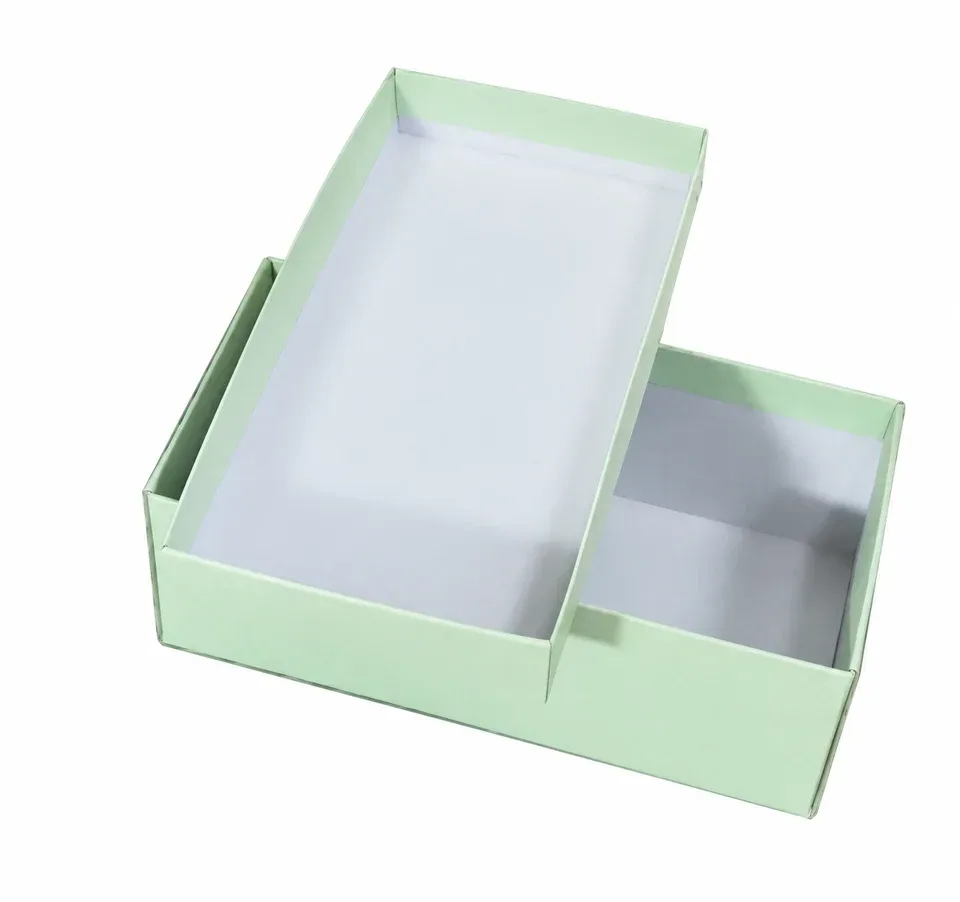
A lid-and-base box is formed as two parts. The lid and the base are made separately, and the fit between them is a result of both drawings rather than of one.
That difference reaches the tooling before it reaches the quotation. On a hinged box, the lid position and the edge folds are part of the same forming sequence. On a lid-and-base box, two parts have to be formed, matched and collected.
The catalogue keeps the families apart as well. Xunding lists hinged-lid shoe-box equipment separately from the fruit tray range, and the lid-and-base family sits with it rather than with produce trays.
A photograph of a closed box rarely shows the difference. The lid line sits on the top face, and a separate lid looks much the same once it is in place. Ask for one photograph with the box open and the lid beside the base, which settles the question in a single frame.
What changes in the forming sequence
The lid type changes three steps after the blank is fed: how the box closes, how it leaves the machine, and how the parts are handled at the end.
Closing the lid
On a hinged box the lid is closed after forming, and the catalogue names that step. XD-Z13 lists automatic lid closing among its functions, and XD-Z14 describes glue spraying, servo feeding, forming, box removal, lid closing and box sorting as one sequence started with one button.
On a lid-and-base box there is no lid to close. The lid has its own forming pass, and the question moves to how the two parts are matched and collected rather than how one lid is closed.
Two drawings instead of one
A lid-and-base box needs both drawings, and the box-format library says why: the lid has to fit the finished base after folding and joining. A lid drawn to the base's nominal size can still miss once the base has been folded and glued.
That is why the library asks for both blanks and a fitted sample. It also asks the supplier to confirm whether the proposed setup forms each part separately, and how the parts are collected.
What the drawing has to mark
The catalogue names three things that affect the tooling and the closing operation on a hinged box: box depth, lid position and edge folds. All three are drawing values, and none of them can be read from a finished box with the lid shut.
What the box is used for
Both models are described for footwear, clothing, crafts, daily goods, electronics, electrical products, hardware and standard parts. The application list does not separate the two lid types, so it does not help you choose between them.
The lid structure does. A box that opens on a hinge and a box whose lid lifts off behave differently on a retail shelf, and they behave differently at the machine.
Which models the catalogue actually covers
This is the part buyers check last and should check first. Coverage is a capability boundary, not a configuration option.
| Model | What the catalogue lists | What that means for your drawing |
|---|---|---|
| XD-Z13 | Boxes with an integrated hinged lid, formed with hot-melt glue and automatic folding | Hinged-lid structures are covered; lid-and-base boxes are not listed for this model |
| XD-Z14 | Both integrated hinged-lid boxes and separate lid-and-base boxes, with forming, lid closing and box sorting | Both families are covered, and the lid-and-base job includes handling two formed parts |
Only XD-Z14 carries both families in its catalogue entry. That sentence is the whole comparison. It is also where a quotation can go wrong quietly, because both models are described in similar language everywhere else.
The two entries also share a finished box range. Both are listed for boxes from 165 to 380 mm long, 100 to 280 mm wide and 70 to 125 mm high. A dimension check alone will not tell you which model the job belongs to.
Three catalogue dimensions that decide the job
Both models list the same three figures, and all three come from the drawings rather than from the machine.
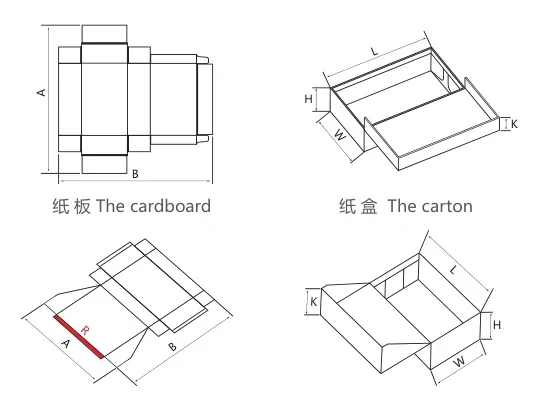
Lid dimension K
The catalogue labels a lid dimension K and lists 30–125 mm for both models. It is the figure to read from your own lid drawing before the tooling is discussed.
Inside fold edge R
The catalogue also labels an inside fold edge R, listed at 20–40 mm for both models. Like K, it is a drawing value that has to be supplied, not a setting an operator dials in.
This page does not explain what K and R do mechanically beyond those catalogue labels. The machine file and the tooling drawing are the places to settle that, and a supplier can answer it against your sample.
Flat blank A and B
Both models list flat blanks from 345 to 710 mm in direction A and 470 to 945 mm in direction B. The figures are limits on each direction rather than a promise that every combination inside them runs.
For a lid-and-base box the blank question doubles, because two blanks have to sit inside the range and be formed in the same setup. That is the practical reason the library asks for both drawings rather than one.
A stack figure appears in the same technical table, and it is worth reading correctly. The stack height and stack load describe the cardboard stack at the feed section, which is how much board the machine holds. They say nothing about the strength of a finished box.
Board thickness narrows the list in the same place. Both models are listed for board from 1.5 to 3 mm, so a board outside that band is a different conversation rather than a lid question.
What to send with an enquiry
The list differs by lid type, and the difference is small enough to miss.
For a hinged-lid box, send the open blank and a closed sample, including the lid tabs and the folded edges. Review forming, closing and discharge together. The lid has to close after forming, and the box has to leave the machine in a state the packer can use.
For a lid-and-base box, send both blanks and a fitted sample. Ask whether the proposed setup forms each part separately, and how the parts are collected at the end. A lid that fits on the bench and not after gluing is a drawing problem, and it is cheaper to find on paper.
Both requests benefit from the same additions: board grade and thickness, print and coating details, the K and R values from your drawings, and the number of formats you expect to run in a season.
If one line runs a hinged shoe box and a lid-and-base gift box in the same season, send both drawings in one enquiry. Two separate enquiries tend to produce two quotations that cannot be compared on the same terms.
How to photograph a box for machine selection covers the photograph set that saves a round of questions. The hinged-lid sample group and the lid-and-base sample group show which details are worth photographing on each.
Final thoughts
The lid is the cheapest thing to check and the most expensive thing to get wrong, because it decides which model can be quoted at all.
If the lid stays attached, the job sits in the hinged-lid family. If the lid lifts off, the job needs both parts formed and matched, and only XD-Z14 lists that family alongside the hinged one.
Send Xunding the blank or blanks, a fitted sample and the K and R readings from your drawing. That answers the lid question before a model is proposed, and it keeps a two-part box from being quoted as a one-part job.
Send your lid and base drawings to Xunding for a coverage check
Frequently asked questions
Can one machine form both lid types?
In the Xunding range, XD-Z14 lists both integrated hinged-lid boxes and separate lid-and-base boxes. XD-Z13 lists the hinged-lid family, and the catalogue does not list lid-and-base boxes for it. Confirm the drawing against the selected model before the order, because the two jobs need different handling at the end.
Does the lid type change the tooling?
It changes what the machine has to do after forming. A hinged box closes its lid and is sorted as one piece, while a lid-and-base box produces two parts that have to be matched and collected. The catalogue describes those steps separately for the two models, so the tooling question follows the drawing rather than the model name.
What if my lid has to fit a base made somewhere else?
Send both drawings and a fitted sample, and say which part is made where. The lid has to fit the finished base after folding and joining, so the fit is checked on assembled parts rather than on flat blanks. A supplier can then confirm whether the proposed setup forms one part or both.
Do the two models differ in box size range?
Both are listed for the same finished box range, from 165 to 380 mm long, 100 to 280 mm wide and 70 to 125 mm high. Both also carry the same lid dimension K and inside fold edge R. Size does not separate them. The lid structure does, which is why the drawing decides the model.