


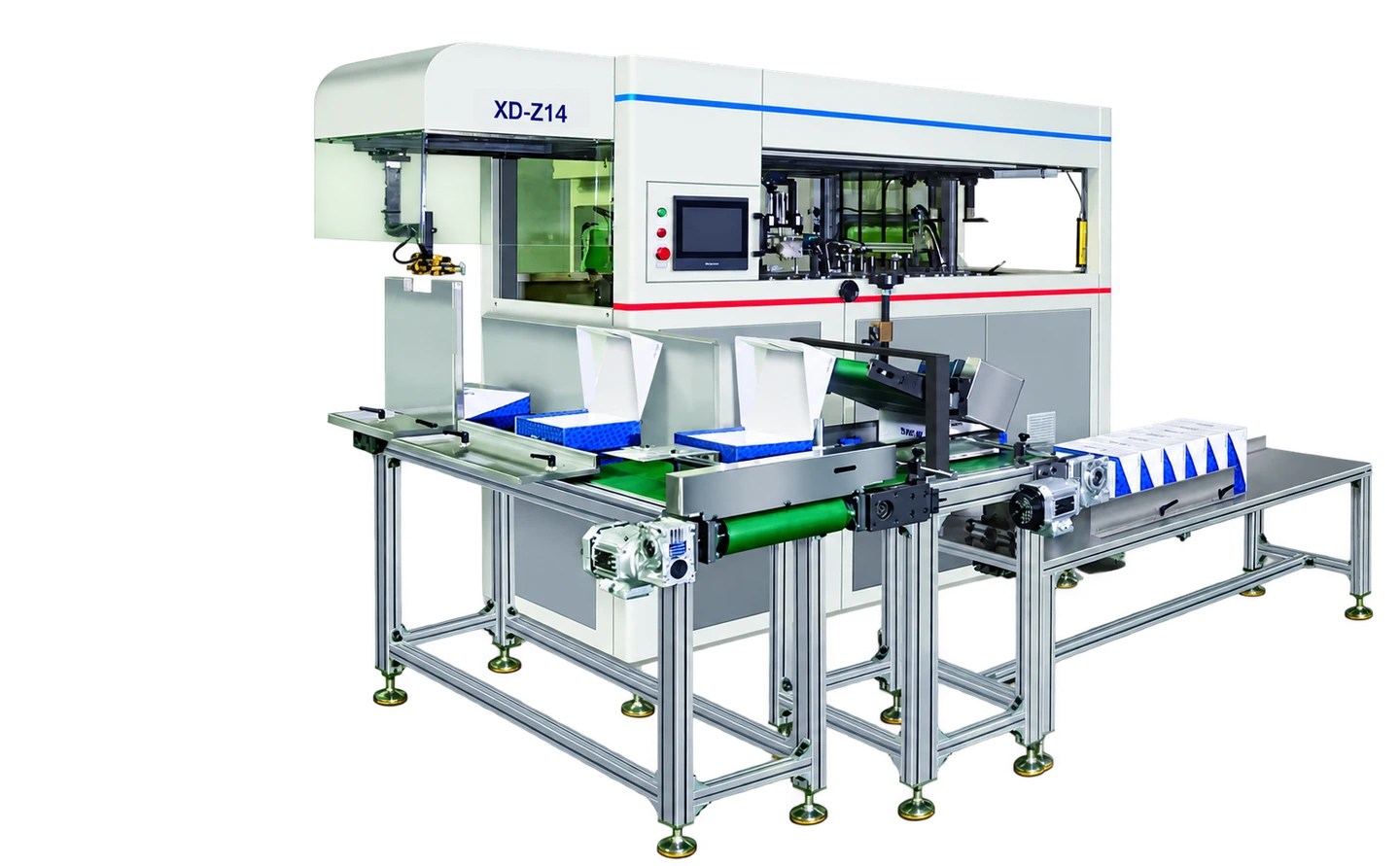
Xunding box forming machines generally fall within US$10,000–50,000, while carton sealing machines generally fall within US$500–4,000. These are indicative budgeting ranges; a project quotation confirms the price and the equipment supplied. First identify the task: forming a flat blank into a box is different from sealing an already erected carton. Then compare the box design, configuration and written scope rather than the price alone.
Indicative prices: box forming versus carton sealing
A fruit tray former folds and, where the reviewed design requires it, glues a flat blank into a finished tray. A carton sealing machine closes an already erected carton with tape. The two jobs are not interchangeable: the lower carton sealing price range is not a budget for a fruit tray forming machine.
Use the ranges below for an initial purchasing discussion. Ask the quotation to state the currency, machine model, configuration and included equipment. Also ask whether packing, freight, taxes, commissioning and other project costs are included or separately charged. This guide does not specify a standard all-inclusive package.
| Equipment category | General price range (USD) | Buying task |
|---|---|---|
| Box forming machines, including fruit tray forming | US$10,000–50,000 | Form a reviewed blank into the required box structure |
| Carton sealing machines | US$500–4,000 | Tape-seal an already erected carton |
Compare fruit tray forming candidates
Review carton sealing equipment for a different packing task
How box complexity changes the quotation
A straightforward forming task with one reviewed box format and fewer handling requirements generally belongs nearer the lower end of the forming budget discussion. More involved folds and joints, several formats with additional tooling, or extra conveying and stacking can move the quotation toward the upper end. The box drawing and requested configuration decide the scope; the fruit name alone does not establish complexity.
Describe every intended box, the changes between them and the tasks before and after forming. Do not assume that every design within the same outside dimensions uses the same tooling or forming actions. No smaller price bands are assigned to individual difficulty levels here: the exact price is confirmed for the proposed machine and project.
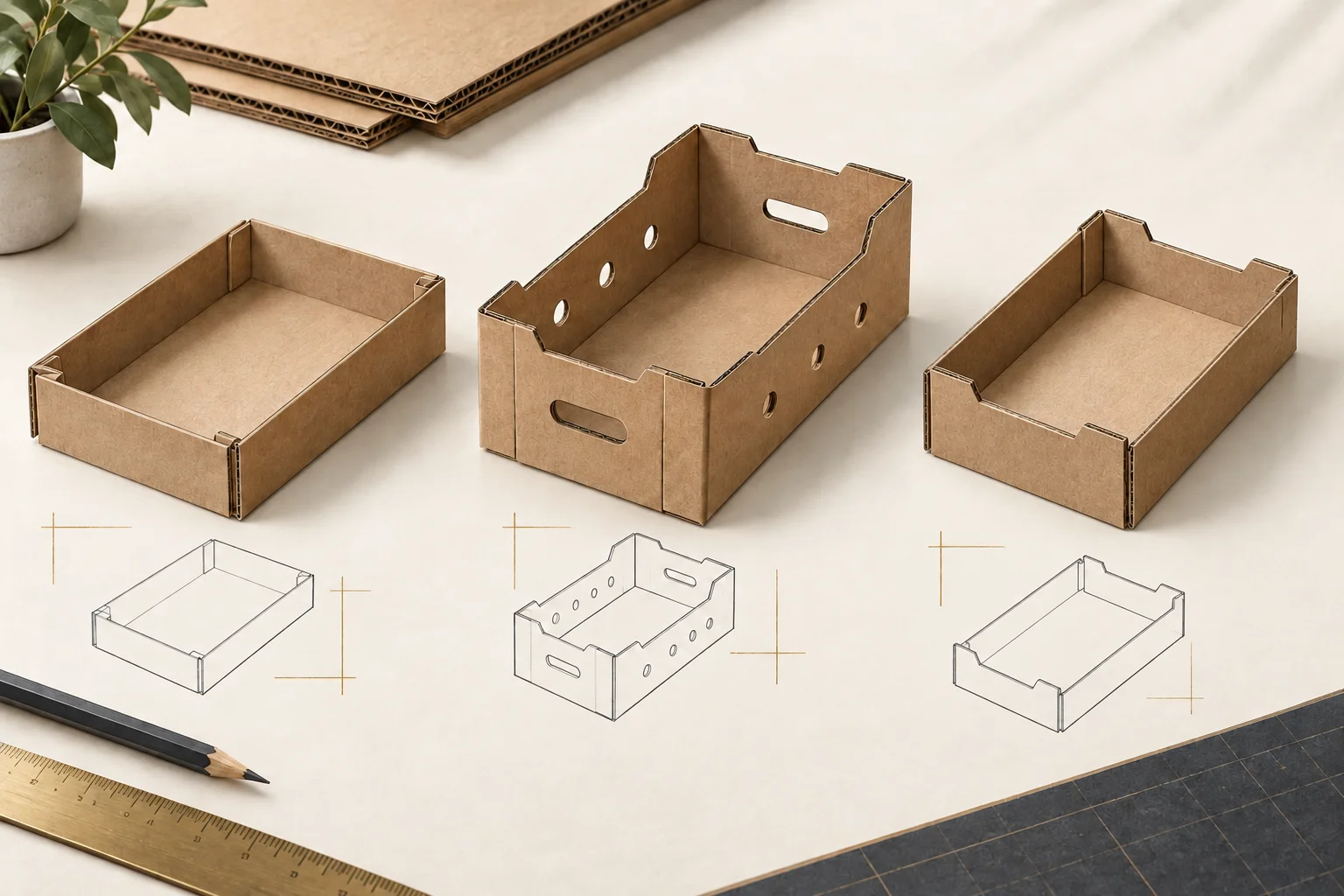
Prepare the formed box, blank and finished dimensions
See how a multi-size orchard enquiry becomes a configuration brief
Prepare a box brief before comparing prices
Send a blank drawing, finished-box dimensions and photographs of an assembled sample. Add board type and thickness, the proposed adhesive requirement and the output you need. List each design if you expect to make more than one box.
Include the installation country and site voltage, phase and frequency. These details help prevent quotes for different configurations from appearing equivalent. For example, an open fruit tray and a hinged-lid shoe box need different forming arrangements even if their dimensions are similar.
Ask what is included in the quoted configuration
Identify the model, feeding method, forming and gluing functions, conveying and stacking arrangement. Ask which tooling or size-change parts are included and which are optional. The written scope should match the designs discussed in the enquiry.
Machine price alone cannot show the cost of the proposed setup. Request separate details for any optional items, packing, transport, commissioning and spare parts you need. Xunding prices and delivery schedules are provided by quotation for the specified project; this website does not publish a universal price or stock promise.
A side-by-side quotation scope checklist
Put this checklist beside each proposal. For every item, record its details and mark it included, optional, excluded or to confirm. A missing line is a question to resolve, not proof that the item is supplied at no extra charge.
For a hot-melt glue tray former, identify the actual adhesive equipment, application arrangement and box joints to be formed. Ask whether the glue unit, hoses and applicators are part of the quoted configuration. For several tray formats, list the tooling and size-change parts for each one. Do not infer these details from a photograph or a general product description.
| Scope item | Details to record for both quotations |
|---|---|
| Machine and feeding | Model, reviewed box designs, feeding arrangement and forming functions |
| Glue equipment, where applicable | Glue unit and application arrangement; included components and consumables |
| Tooling and size changes | Tooling for each format, extra sets, adjustments and change parts |
| Conveying and stacking | Outlet arrangement, collection method, conveyors and stacker scope |
| Site utilities and layout | Voltage, phase, frequency, required air supply and installation space |
| Sample trial | Drawing revision, actual board, finished-box checks and output recording |
| Commissioning and support | Installation, training, service scope, spares and separately charged work |
| Packing and delivery | Packing, delivery terms, freight, taxes and responsibilities |
Keep purchase price and running costs separate
The quoted machine price answers what you are buying. The cost of producing accepted trays is a separate question involving labour, adhesive, energy, material losses and the production time actually available. Compare those inputs over the same period and output quantity rather than choosing on the purchase price alone.
Record known figures and leave unknown inputs open for review. A general price range cannot establish cost per tray, payback time or a guaranteed saving. Use your production brief and an agreed sample trial to refine the operating discussion.
Agree how the machine and sample will be reviewed
Specify the board and blank to be used for a demonstration or sample check. Agree the finished-box checks, required output and changeovers that need to be shown. Keep those requirements with the model and configuration in the purchase discussion.
Request the documents applicable to the exact equipment and destination. Check the company, model and scope identified in any certificate or technical document. A general certificate image is not a substitute for reviewing the paperwork for the quoted machine.
Make the quotation easy to compare
Put the box requirements, included equipment, electrical supply, acceptance terms and delivery scope side by side. Clarify anything missing before deciding which quote matches the job. A lower price for a different forming task is not a useful comparison.
Contact Jason Chen with the completed box brief and the models you would like to discuss. If you have not chosen a model, describe the packaging first. The aim is a quotation tied to your production requirement, with the configuration and commercial terms confirmed in writing.
Quotation FAQ: glue units, extra formats and delivery
Does every fruit tray former quotation include a glue unit? Ask for the components included in the specific proposal; this guide does not make a range-wide inclusion promise. The reviewed blank determines the forming and joining task.
Does a machine that handles several sizes include every tooling set? List the intended formats and ask which sets and change parts are included. A size range alone is not a list of supplied tooling.
Does the quoted machine price include delivery and installation? Record the delivery terms and the agreed installation, commissioning and training scope in writing. Identify any separately charged items before comparing totals.
Request a project quotation with your box and production brief
Catalogue models to discuss
These models are starting points for an enquiry. Confirm the configuration against your blank and sample.
- XD-Z03 · Multifunctional box folding machine
An automatic fruit-box forming setup combining bottom-suction feeding, folding knives, gluing, conveying and stacking.
- XD-Z13 · Automatic hinged-lid shoe box machine
Forms cardboard boxes with an integrated hinged lid for footwear, clothing and general product packaging, using hot-melt glue and automatic folding.
- XD-Z14 · Hinged-lid & lid-and-base box machine
Automatic forming for integrated hinged-lid boxes and separate lid-and-base boxes, including footwear, clothing and other product packaging.