


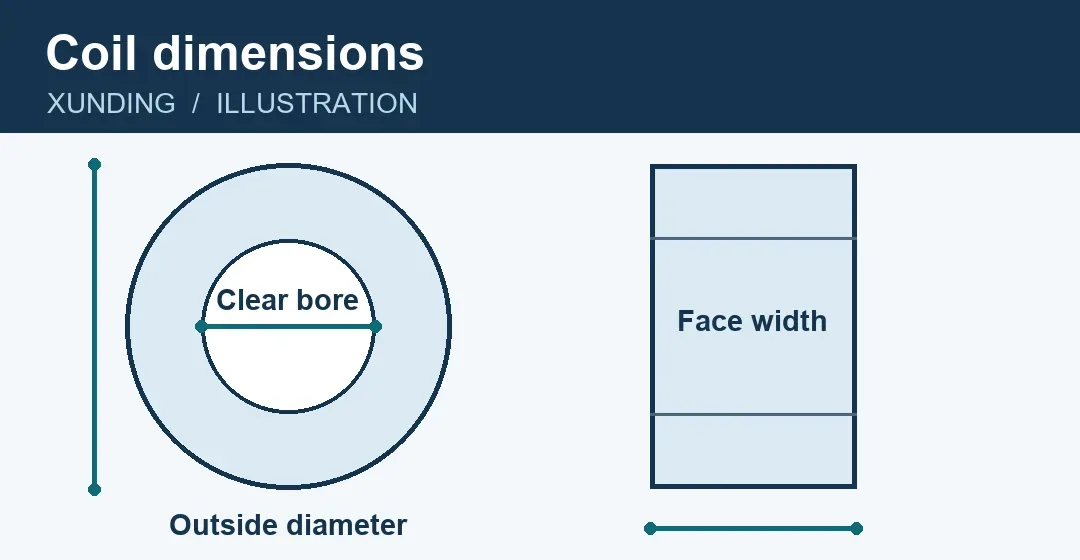
A coil wrapper quote needs a drawing of the coil as it arrives at the machine. The nominal outside diameter gives only one dimension. The film path may have to pass through a bore partly occupied by a tie or sleeve, and the coil still needs a way to enter and leave. A front view, side view and loading sketch give the supplier enough information to review those interfaces.
Measure the usable opening
Mark outside diameter, inside diameter and face width, all in the same units. Show the smallest clear opening with ties, cores and sleeves in their normal places. Give the dimensions for each actual coil family rather than combining extremes that never occur together. Flag oval openings or protruding ends on a photo. Include the maximum gross mass and the parts of the coil that support it.
Show how the coil arrives and leaves
Indicate whether the coil lies flat or stands upright at the station. Sketch the lifting or conveying method and where it contacts the product. If rotation or upending is needed before wrapping, show it as a separate operation with its own space. A coil that fits the wrapping path still needs to reach its supports and leave without interfering with the wrapped surfaces.
Mark coverage and trial cases
Mark where you want film on the inner surface, outside circumference and both faces. Identify any area that needs to stay clear. Use the tightest clear bore and the heaviest coil in the trial list; if they are different products, list two samples. Agree how to check the film start, overlap, tail and condition after the normal handling step.
Ask for the drawing with worst cases marked
For each selected trial sample, pair the clear opening with its own outside diameter and width. A heavy narrow coil and a lighter wide coil can ask different questions of the same machine. Keep a view of any projecting tie end or protective edge piece with its dimensions. Ask which example limits the proposed layout and why. A useful supplier response points to the clearance, support or loading step that drives that limit, then identifies the actual sample it wants for a check.
Send the drawing before choosing a model
Review the coil and ring application and the stretch wrapping range with the dimensioned drawing. Ask the supplier to mark the film path, support layout and loading direction on the proposal. Keep clearance confirmation for the selected configuration open until that drawing and the representative sample have both been checked.