


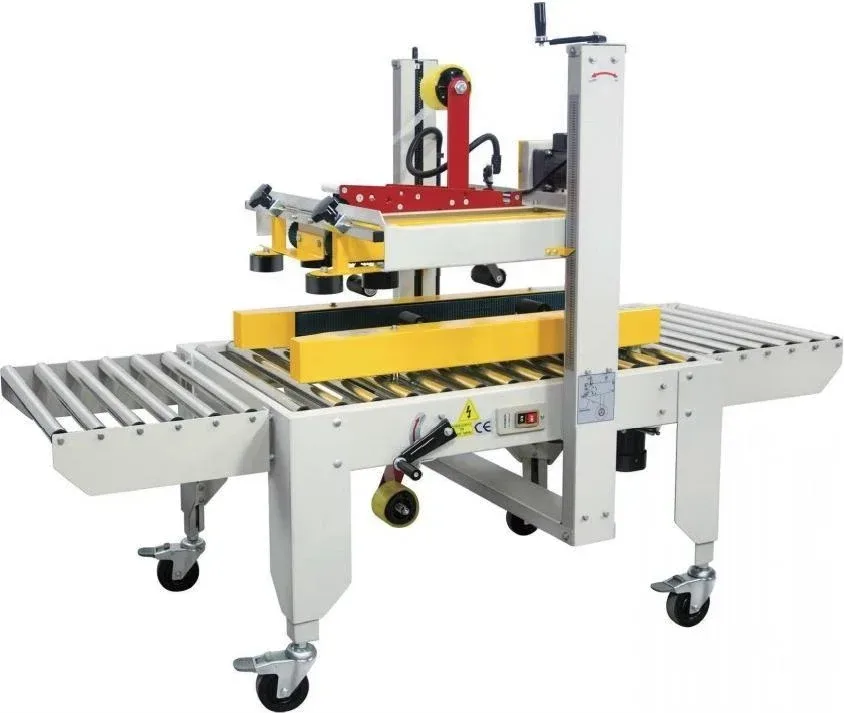
One torn seal does not tell you which part of a case sealer needs attention. Before making an adjustment, save the carton, photograph the seal and note where the fault appeared. A tape strip that runs crooked, a strip that lifts at the end and a tape head that fails to cut give you different starting points. Use the instructions for the installed model. Take the machine out of service if there is a fault involving the drive, guards, cutter or controls. Any inspection inside a danger zone, adjustment or component replacement belongs to trained personnel following the site isolation procedure and the manufacturer's instructions.
Signs that need attention
| What you see | What to compare first | Evidence to save |
|---|---|---|
| Tape wanders off the centre seam | The seam enters off-centre, or the tape line moves on a square carton | Photograph the carton before and after the sealer |
| Tape end lifts | Contact area, surface condition and tape specification | Keep the failed seal, tape lot and board reference |
| Tape stays attached between cases | Whether the same problem occurs on a known good carton with the specified tape | Stop the run and note the machine and tape-head identifiers |
| Carton travels at an angle | Case squareness, flap presentation and which surfaces contact the belts | Take a top view and a side view at the infeed |
When can you correct the setup?
Check a failed carton against one from the last accepted batch. Bring both from the same stage of packing, with the contents fitted as they are in production. If the faulty carton already arrives skewed or the flap lifts before entering, correct the input condition through the packing procedure and repeat the approved first-case check.
If you changed tape rolls just before the fault, check the specification and lot. The XD-FX5050 lists 30–50 mm tape. The XDZG5050 lists 50–70 mm tape. Read the tape-head instructions for the fitted arrangement rather than carrying settings from one machine to the other.
When should you request a repair?
If the fault persists on a known good case and specified tape, stop adjusting unrelated settings. Record the model, tape-head reference and the first point at which the outcome changes. Ask service which assembly to inspect and which replacement part matches it. An intermittent cut fault reported with a sample, error message and tape lot is easier to reproduce than a report that the machine “sometimes goes wrong”.
What to do after the fault is corrected
Review a first case under the normal guarded procedure, then run enough of the affected size to check whether the same defect recurs. Inspect tape position, end overlap and bond on the actual board. Save the result next to the original defect. Changing board, tape and setup together may restore output, but the record will not show which change solved the fault.
If you need assistance, send the fault record and model details to Xunding. For a quotation involving a new type of carton, use the case sealer comparison to check which station is expected to control the flaps.
Manufacturer’s Joint or Closing Seam? Trace the Fault on a Sealed Carton
A carton reaches dispatch with a gap. Before anyone changes the tape setting, put a finger beside the gap on a stationary sample. Does it run down a vertical corner or along the meeting edges of the top flaps? The answer sends the investigation to different stations.
Follow the vertical joint
A conventional slotted case arrives with its manufacturer's joint already made. Open a spare flat case from the same bundle and look for the overlap that joins the body panels. If the overlap peels when the case is squared by hand, save that sample alongside the failed case. A strip across the top cannot repair a weak joint running down the side.
Follow the top seam
For a top opening, inspect whether the flaps meet before the tape lands. Compare an empty case with a normally packed one. A product lifting one flap creates a different fault from tape centred on a flat top but lifting at its ends. Photograph the top before sealing and again at discharge; label both photos with the same case ID.
What if the side opens only after filling?
Retain one flat case, one erected empty case and one normally filled case from the same lot. Mark the failed corner on each. If failure follows one product orientation, check where that product presses on the side wall. Give the case converter the failed filled sample as well as the unopened blank.