


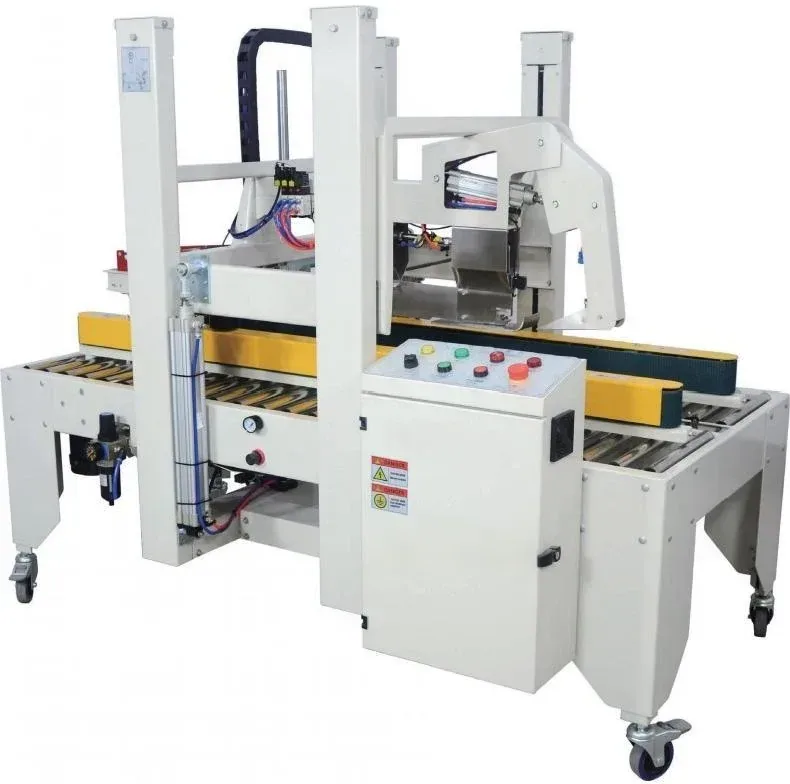
Automatic vs semi-automatic case sealers differ in one step: who closes the four top flaps. On most packing lines those flaps sit on an RSC, the regular slotted container. A semi-automatic sealer tapes a carton an operator has already closed. An automatic flap-folding sealer closes the four flaps itself, then applies the tape. Tape is powered either way, so the choice is about who folds. Install a tape-only sealer where packers still close cartons by hand and you have bought a tape dispenser with a conveyor attached. The fold does not disappear from the cycle; it moves one step back, to the person who was already busy.
Follow one packed carton from the bench to discharge
A tape sealer only sees the carton in the state it arrives.
Flaps already folded by hand. The packer closes the carton and checks the contents in one movement. The fold is already paid for. Powered taping removes the hand dispenser and the crooked second strip, and a tape-only sealer fits that bench as it stands.
Open-topped cartons arriving on a conveyor. Somebody has to space them, align them and present them square to the folding section. In most plants that somebody is a person standing at the machine. See the carton transfer in the photographed packing line for the arrangement at a customer site.
Mixed sizes arriving one after another. A line running three avocado sizes delivers cartons in an order nobody chose for the machine's convenience. That order, not the published range, is what a folding section has to accept.
Two conditions decide whether any of this works. The product has to sit below the flap line, and the flaps have to stay down once folded. Both are properties of your carton and your pack, not the machine.
Cartons that reach the sealer damaged or badly erected hand it a fault it cannot fix. That is why the carton that arrives at the sealer is already the problem.
Who folds the flaps: semi-automatic vs automatic case sealers
A semi-automatic carton sealer applies tape to a carton an operator has already closed. That operator folds the two minor flaps, then the two major ones, squares the box and hands it to the tape head. The machine supplies the tape and the belt drive, nothing else. It suits a bench where one person packs and checks the contents, and where cartons arrive one size at a time.
It is not an automatic flap folder, and it does not reset itself between sizes. Those are two separate features, not part of the taping step.
An automatic flap-folding case sealer folds the four top flaps and then applies the tape. The operator loads at the infeed and takes the sealed carton off at the outfeed. It suits a line where open-topped cartons arrive on a conveyor with nobody free to close them.
It is not an automatic size-change machine, and it does not erect cartons. The fold is the only step that moved.
| Step | Operator only (hand taping) | XD-FX5050 | XDZG5050 |
|---|---|---|---|
| Fold the two minor (end) flaps | Operator | Operator | Machine — automatic flap folding |
| Fold the two major flaps over them | Operator | Operator | Machine — automatic flap folding |
| Square the carton, line up the centre seam | Operator | Operator presents the carton square to the tape head | Operator presents the carton; the machine closes the flaps |
| Feed the carton to the tape head | Operator | Operator loads at the infeed | Operator loads at the infeed |
| Apply the tape | Hand dispenser | Machine, 30–50 mm tape | Machine, 50–70 mm tape |
| Discharge | Operator lifts and stacks | Carton leaves at the outfeed — arrangement per quotation | Carton leaves at the outfeed — arrangement per quotation |
| Change the size setting | Not applicable | Manual setting between batches | Manual setting between batches — flap folding does not bring automatic size change with it |
| Carton range | — | Length 130 mm and up, no maximum stated; width 140–500 mm; height 130–500 mm | Length 200–500 mm; width 130–500 mm; height 130–500 mm |
| Capacity | — | 800–1,000 standard cartons per hour | 600–800 standard cartons per hour |
Flap folding is the only production step that moves from the operator to the machine. Loading, squaring and discharge stay with the operator on both models, which leaves one fold fewer per carton.
The capacity figures are catalogue figures: the numbers published in the spec sheet, measured on the carton types it names. They are not your shift, and subtracting one model's figure from the other's does not price the automation. The ranges differ as well. A carton below 200 mm in length falls outside the flap-folding model, whatever the speed figure says.
Separate flap handling from size adjustment
Automatic flap folding and automatic size adjustment answer different questions. One closes a box, the other sets the machine for the next box.
A machine can fold flaps on every carton and still need a person between batches, moving guides and resetting the folding rails. Both Xunding sealing models sit in that category, so setting between sizes is manual work that the spec sheet should quantify.
Closure is a specification of its own. ASTM D1974 is the recognised practice for closing, sealing and reinforcing corrugated boxes. The method you choose drags material, labour and machine time with it.
- Ask how long a size change takes and what has to be touched. "Quick" in a sales conversation becomes a number in an acceptance record.
- Ask whether changeover differs between the two. More stations usually means more to set.
- If you run one size for weeks, setting time barely matters. If you change twice a shift, it belongs in the trial.
Mixed-size batches and consecutive different sizes are not the same request. A machine that accepts each of your sizes is not automatically a machine that accepts them arriving alternately. Say which one you need.
Do automatic case sealers save labour? Ask three questions instead
"How many people does it save" is the wrong first question. It invites a number nobody can defend yet.
- How many cartons per shift, over how many hours? Daily cartons divided by packing hours is a planning average. It is not the rate the sealer runs at.
- Is the person folding flaps dedicated to that task? If the same person packs, weighs, labels and stacks, folding is a few seconds inside a longer cycle. Removing those seconds changes the cycle, not necessarily the headcount.
- What else happens at the bench in the same minute? Tape replenishment, label printing, quality checks, pallet changes. None of it vanishes when flaps become automatic.
Measure instead of arguing. Count accepted cartons at discharge over an agreed interval, and log every stop with its reason and minutes. The stops to log are loading, alignment, size change, tape change, jam clearance and rejected seals. That rate compares with the bench's own supply, and it ends the argument faster than any demonstration.
What the carton does to a flap-folding case sealer
Most comparisons skip this, and it decides the outcome. A carton sealer is a set of guides, belts and a tape head expecting a square box with flaps lying flat. Your carton decides whether it gets one.
Flaps that spring back. Corrugated board has memory, so a flap folded and released may lift a few degrees. A hand-folding operator holds it down by instinct. An automatic folding section commits the flap to a path and moves on. Fold a sample by hand, release it, and watch the crease.
A pack that sits above the flap line. Measure the filled carton, not the empty one. Product standing proud of the flap crease pushes the flaps up, so the folding section closes onto product rather than board. Soft fruit packed to the top does this often.
A carton knocked out of square. Cartons dropped, stacked unevenly or erected on a worn erector arrive slightly rhomboid. The centre seam wanders, the tape lands off-centre, and the carton shifts as it passes. Measure both diagonals across the top opening. If they differ, fix it upstream before blaming the sealer.
Board that has taken up moisture. Fruit from a cold room arrives damp, so flutes crush more easily under the folding rails and the box loses compression strength. Let cartons acclimatise where the process allows, and test tape on the board at temperature.
A printed surface where the tape lands. Varnish, heavy ink and a dusty recycled liner all reduce tape grip. Ask for a seal test where the tape sits on your print.
Every item above is settled before the machine is chosen, and a photograph, a measurement and a filled sample settle it. That is why suppliers ask for photographs and measurements of the carton before the trial instead of a description.
What happens in the gap between two cartons
The sealer never makes a carton; it only closes the one in front of it. The gap between cartons is set upstream, by the packing bench, the erector or the conveyor, and by whoever is loading.
Two patterns behave differently: continuous infeed delivers cartons nose to tail, gapped infeed leaves space, and the folding section waits between cycles. Both are normal, and they are not the same trial.
A gap that is too large shows up as an idle folding section and an operator waiting with a carton in hand. A gap that closes up shows up differently. Cartons back into each other, get handled twice, and reach the folding rails out of square. The tape head cycles either way.
Neither symptom appears in a catalogue figure, and both appear in the first hour of a run at line pace. Record the spacing you actually run at, not the spacing the machine prefers. Then note whether the folding section kept up or fell behind.
Use the bottleneck to choose the trial
Now run it. A trial with one perfect carton at one size proves nothing. Your line never does that.
- Bring filled cartons, not empty ones, including your shortest and tallest.
- Run them in the order your line produces, smallest and largest included, mixed sizes adjacent where that happens.
- Present cartons at the pace the packing bench can supply, not the pace the machine prefers.
- Keep running through at least one tape roll change and one size change, and confirm both timings on the spot.
- Record everything as it happens.
| What to record | Unit | Record it with |
|---|---|---|
| Accepted cartons | count per agreed interval | Carton size, tape roll, operator |
| Flap-folding success | cartons closed correctly / cartons presented | Pack height, flap condition |
| Jams in the folding section | count, plus minutes lost | Which flap, which size |
| Size change time | minutes, from last good carton of size A to first good carton of size B | The exact pair of sizes used |
| Tape change time | minutes | Tape width and roll length |
| Rejected seals | count and cause | Tape placement, flap contact |
| Operator actions during the run | list | Which steps the machine did not take |
Keep the record with the carton sizes and the tape lot. Buyers use the same discipline to record output and changeover during acceptance. Trial and acceptance should be one test, run twice.
Questions to settle before ordering
Can one operator still run an automatic flap-folding case sealer?
Yes. The machine removes the folds, not the post. Cartons still have to be loaded at the infeed, tape replenished and seals checked. Whether that leaves one person free or merely less rushed depends on the packing bench.
Can a carton sealer run a carton shorter than 200 mm?
XD-FX5050 lists length from 130 mm with no maximum stated, and XDZG5050 starts at 200 mm. A carton below that line is a tape-only job unless the written configuration says otherwise. The range table above carries the rest.
What should a case sealer trial record?
Accepted cartons per interval, flap-folding success, jams with minutes lost, and size change time. Add tape change time, rejected seals with causes, and the steps the operator still performed. Record every line against the carton size and the tape lot.
Put each of these in writing before any sealing machine is ordered, from any supplier. Then confirm the answers against the written configuration. Answers that arrive only in conversation change after the purchase order.
- Carton range. Minimum and maximum length, width and height in millimetres, internal or external. Include the sizes you intend to add next year.
- Tape. Width and type. XD-FX5050 lists 30–50 mm and XDZG5050 lists 50–70 mm. A tape outside that range is another conversation.
- Working height. Both models list a table height adjustable from 550 to 740 mm. State the height that matches your conveyor.
- Size change. What is adjusted, by whom, and how long it takes between your sizes.
- Mixed batches. Whether consecutive different sizes are supported, and when.
- Utilities. Voltage, frequency, phase, and air supply if the configuration needs one. Site voltage delays installation more often than any other item.
- Scope of supply. Conveyors, infeed and outfeed sections, tape head, guards, and who connects what.
- Spare parts and training. Wear parts, recommended spares, and who trains operators and maintenance staff.
Machine details for both models sit on the carton sealing machines: tape-only and flap-folding models page. Use it to confirm ranges, not to make decisions.
Final Thoughts
Three things decide it: who folds the flaps today, whether the whole range sits inside 200–500 mm, and whether folded flaps stay down on a filled carton.
Choose XD-FX5050 if cartons reach the sealer already folded and square. It also fits when the packer has spare seconds in the cycle, or when the range runs outside 200–500 mm. It is a tape sealer added to the bench you have.
Choose XDZG5050 if open-topped cartons arrive on a conveyor with nobody free to fold them. The range has to sit inside 200–500 mm length. It is the right machine when the trial shows the flaps closing reliably on filled cartons.
Either way, the inquiry needs five items. A carton sample or photographs, the size matrix with all limits, and cartons per shift with the hours they run in. Add the workshop layout and the site voltage. Then compare what each configuration costs to buy and run.
Send your carton photos, size matrix and shift count to Xunding for a configuration check
Catalogue models to discuss
These models are starting points for an enquiry. Confirm the configuration against your blank and sample.
- XD-FX5050 · Carton sealing machine
Tape sealing equipment for assembled shipping cartons. Compare carton dimensions and tape width before selecting the sealing setup.
- XDZG5050 · Automatic flap-folding carton sealer
Automatically folds carton flaps and seals shipping cartons with tape. The catalogue lists standard-carton output and adjustable table height.