


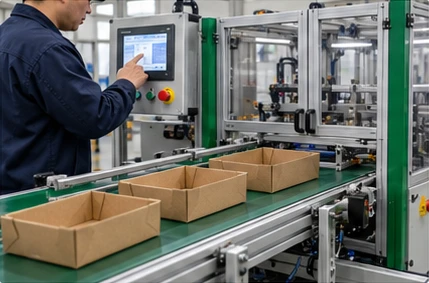
A quotation for a box forming machine always includes a speed figure. The number that matters, though, is the output the machine sustains on your board, with your adhesive, run by your crew. This guide covers what to agree, how to test, and what to record before you sign.
Rated speed is not production output
Rated speed describes how fast a machine cycles under ideal conditions: the right board, a well-set-up box style, and an operator keeping pace. It is a design figure from the specification sheet, not a forecast of what your line will produce each shift.
Sustained output is different. It depends on how long the machine actually runs, how often it needs small interventions, and what share of boxes leave the line as good product. As a checking framework, think of effective output as cycle speed × running time × good-box rate. A machine that cycles quickly but needs frequent attention can deliver less per shift than a slower, steadier one.
So when you compare quotations, ask each supplier what sits behind the rated speed: which board and box size, what feeding method, and whether warm-up time or rejects are excluded from the figure. Check the rated figures against the machine specification sheet, and ask for the conditions behind them in writing.
A supplier who explains the basis of the figure is giving you something you can test. A figure with no stated conditions cannot be verified at a trial — there is nothing to compare against. The goal of the questions above is not to catch anyone out; it is to turn a catalogue number into a testable claim before money changes hands.
How to run an output verification test
An output test is not a demonstration. A demonstration shows that the machine cycles; a verification test measures what it produces over a defined, continuous run. Agree the conditions before the machine is booked for a trial, and put them in writing. At minimum, agree on:
Count good boxes, not cycles. A cycle that produces a reject is not output.
| Item | What to agree |
|---|---|
| Material | The same board and adhesive you intend to use in production, not a friendlier sample stock. |
| Box style and size | The carton you will actually run, erected and checked as a finished box. |
| Run pattern | Continuous operation, with no hand-picked intervals. |
| Records | Run duration, count of good boxes, count and cause of rejects, micro-stops and their causes, and who operated the machine. |
How to measure changeover time the same way
Changeover time runs from the last good box of the previous style to the first stable good box of the new style.
That definition includes changing parts, adjusting parameters, and confirming the first article — not just the mechanical swap of tooling. Changeover time is quoted by nearly every supplier and counted differently by nearly every one, so agree this definition before you compare figures between quotations.
With that definition fixed, the questions to ask become concrete. Which parts have to come off the machine, and who supplies them? How many operators are assumed? What counts as the first stable good box, and who confirms it? If a supplier figure covers only the tooling swap, it is not wrong — but it is not the number your production planning will live with.
If your line runs several box sizes, raise changeover early in machine selection. Ask how format changes are handled on each model — machines such as the XD-Z03 are built for multiple box sizes — and then test changeover during the trial on the two most different styles you run, using the definition above.
What to write into the agreement
A bare number in an agreement protects neither side. What protects both is the test method behind the number. For output, record the board and adhesive used, the box style, the run pattern, who counted, and what counted as a good box. For changeover, record the two box styles involved, the parts changed, the crew size, and the agreed first-stable-good-box rule.
Then connect the results to acceptance. Output and changeover figures from the trial belong in the machine acceptance records, alongside the other documents described in our guide to documentation and acceptance terms. When the same test method is written into the agreement, the trial results become a shared reference instead of a debate.
FAQ: how long should an output test run?
How long should an output test run?
Long enough to move past warm-up and expose the machine’s steady behaviour — which is exactly why the duration should be agreed in writing rather than improvised on the day.
Why agree the test duration in advance instead of deciding on the day?
A short demonstration will show smooth cycling; only a continuous, recorded run shows whether output holds over time. Ask the supplier what run length they consider meaningful, propose what your production requires, and settle the duration before the trial date.
The next step is simple: draft your test conditions — board, adhesive, box style, run pattern, and the records you want — and send them to confirm what can be tested at the factory and how the results will be documented.