


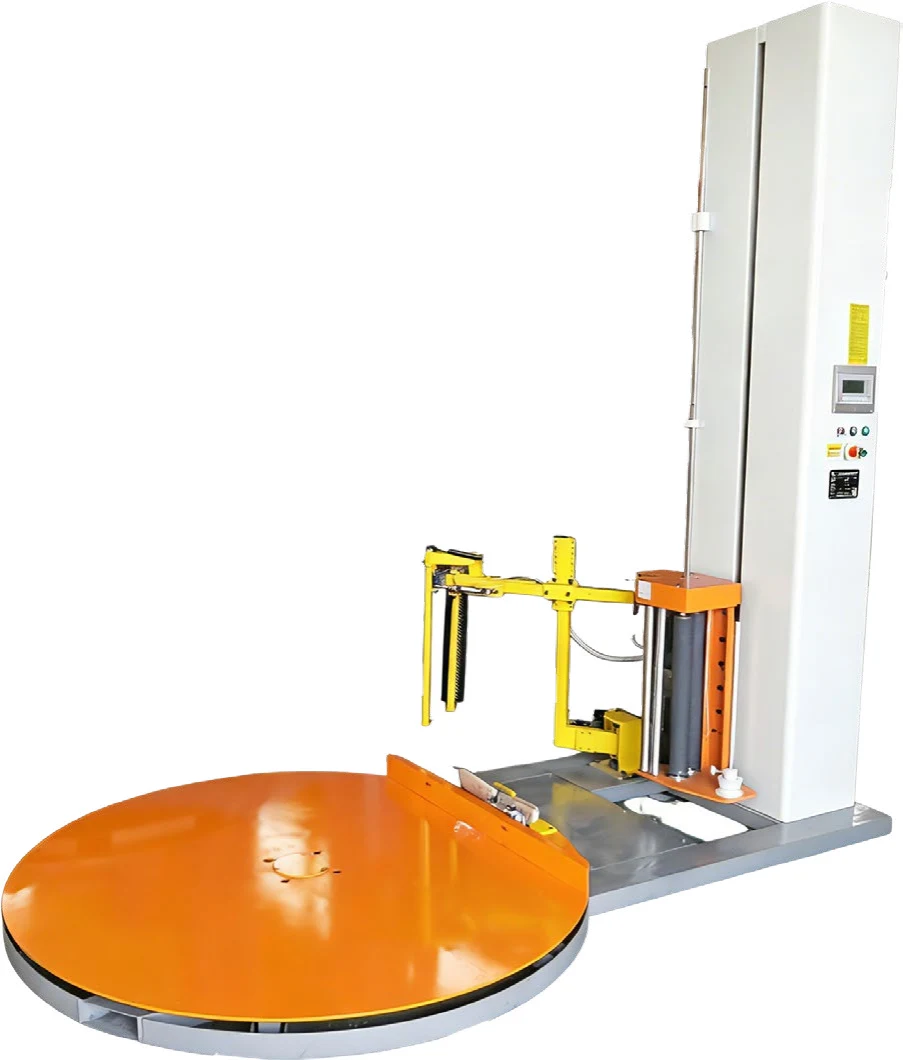
A pallet wrapper can run the wrapping cycle automatically and still need someone to attach the film before the turntable starts and cut it after the last revolution. Those two short jobs determine how the load arrives, when the operator can leave and whether the next pallet can be released. Follow the film from the first attachment to the finished tail before specifying automation.
Where manual attachment fits
A manual attachment arrangement leaves the film head and tail to the person running the station. The machine can still control the number of rotations, carriage movement and film tension. Manual handling can fit a standalone station where a person already positions every pallet and can complete the start and finish within the allowed time. Check where the film is attached on each load and whether the finished tail sits clear of the forks. A quick start on a square carton load may take longer on an irregular load with no convenient attachment point.
What automatic cutting and clamping actually do
Separate three functions in the specification. A clamp holds or presents the film for the next cycle. The cutter separates the film from the reel. The tail finish lays down or secures the film on the wrapped load. A machine described as automatic film cutting does not necessarily include the same tail treatment or pallet-transfer controls as another machine. The catalogue identifies TP1650F-ZF as an automatic film-cutting candidate. Ask the supplier to show where it holds the new film end, how it finishes the old tail and which functions are included in the proposed package.
Compare the entire station cycle
Time a pallet from the point at which it reaches the station until it can move out. Include positioning, attachment, wrapping, cutting and tail inspection. Record operator attendance separately from elapsed time. For a conveyor-fed line, also confirm when the upstream conveyor can admit a new pallet and what the station reports if the film tail is still loose. If manual inspection or fork handling still occupies the cycle, moving one film operation to the machine may have a smaller effect than the wrapping time alone suggests.
Test the film when it behaves badly
Use the film and pallet material intended for regular production. Run representative loads, including the corners and surfaces that make starting difficult. Ask the supplier to demonstrate a planned reel change and the approved recovery after a film break. Keep the observation separate from a normal cycle. Record whether an unfinished load is held, how the station identifies it and what a restart requires. Inspect the tail again after a normal transfer. Film that looked flat on the turntable can lift when a forklift or an adjoining conveyor takes the pallet.
What to put on the comparison sheet
Record wrap start, last revolution, film separated and pallet released as four timestamps. On a manual station, add the time when the operator returns to the pallet. On an automatic station, record any interval waiting for the outfeed conveyor. These timestamps help separate a slow wrapping recipe from a delay before or after the wrap. Add one photograph of the resulting tail on each load type.
Choose by who handles the next pallet
A person-and-forklift station may be well served by a semi-automatic configuration if the start and finish fit the operator’s route. Where pallets arrive and leave on conveyors, write down the accepted tail condition and the release signal first. Compare the automatic film-handling arrangement with an in-line conveyor configuration only after both are priced to the same scope. Provide pallet photographs, film details and expected movements between loads. The useful comparison is how the whole station hands over a wrapped pallet.