


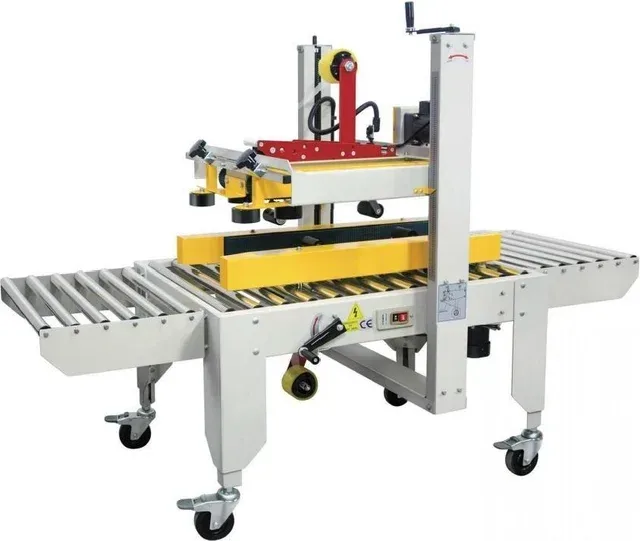
A case sealer on an automated line needs a defined response when the next station cannot accept another carton. Agree which signals represent availability, where each waiting carton can sit and what makes the line ready to resume. Verify the sequence with cases in different positions, including one already entering the sealer when a normal downstream hold begins.
Describe the interface by state
Start with three situations: the next station can receive a carton, it is temporarily unavailable and it has reported a fault. For each situation, write what the sealer may release and what the upstream conveyor may feed. If the controls use signals called ready or blocked, define those terms in the line interface list, including what each receiving controller should observe when the state changes.
Show where the carton waits
Draw the accepted waiting positions on the layout. An upstream buffer, a defined transfer position and the inside of the sealer are different places. Confirm the intended behaviour when a carton has already entered, and inspect any partially processed seam after recovery. Assign ownership of each waiting point and the detection at the handoff.
Test normal hold and recovery
During the agreed line trial, use the normal operating controls to simulate a downstream hold. Start with cases queued upstream, then repeat with a case already at the defined entry position. Verify that the next machine receives only the intended cartons on recovery and that any affected package can be identified. Have the line integrator specify and validate protective functions and safety stops separately under its approved procedure.
Turn the scenarios into test rows
Use one row for each starting position. Record the commanded condition, when new feeding stops, what happens to a case already committed and when feeding is permitted again. Note how the operator can tell that the line is available. A useful record includes the positions of the cartons as well as the signal sequence, so a wiring or timing issue can be separated from a physical obstruction.
Take the state list into the quotation
Provide a transfer drawing showing the case direction, spacing, holding positions and equipment boundaries. Match the case sealer to the conveyor and line modules, then assign responsibility for the interface test. Record the expected carton position before the hold, during the hold and after restart.