


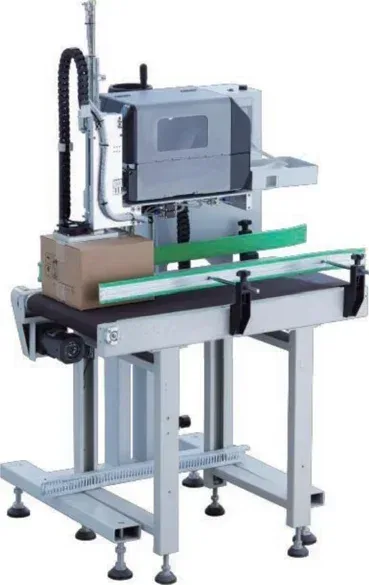
In a fulfilment centre, choose the case sealer around the way orders leave the packing benches. Check whether closed flaps can reach the sealer, how several benches merge and where damaged or unidentified cartons go. Then place sealing, scanning and labelling where a carton stays identifiable and a single exception can be removed without blocking the next wave of orders.
Compare how cartons arrive
A dedicated bench can present one case at a time with its flaps under control. Several benches feeding a common conveyor can deliver irregular gaps and alternating footprints. If upstream staff present closed flaps, the sealer has a different job from a station that receives open flaps on a conveyor. Run the test with the actual arrival pattern, including the burst after a short hold at an upstream bench.
Give the label a clear landing face
Draw the shipping label on a closed sample with the tape path and the leading face marked. Confirm which side faces the scanner at each step and where the carton can still be matched to its order if a label is unreadable. If the label goes on after sealing, test the available flat area and what happens when the case arrives turned or skewed.
Make a physical route for exceptions
Decide where to send damaged cases, unreadable labels and cartons held for a second check. If a reworked carton rejoins downstream, agree how its identity and completed steps are verified before it returns. Include the largest case in a trial and watch how much room remains to remove it without disturbing cartons already queued.
Compare three ways to manage the merge
Where packing benches already control flap position, the simplest layout may be to merge closed cartons before tape is applied. Where flap state varies, fold or present the cartons consistently before entering the sealing section. Where some orders use special labels or carton formats, send them to a parallel route with an explicit point for rejoining or dispatch. Compare the options using the busiest arrival sequence you actually plan to run.
Walk the proposed line with real orders
Lay the carton sequence and exceptions on a simple plan as arrows. Mark the flap state at the sealing station and the label and reject points at the line modules. Agree who provides each transfer. Then run a representative order wave and check that good cartons reach the correct discharge destination.