


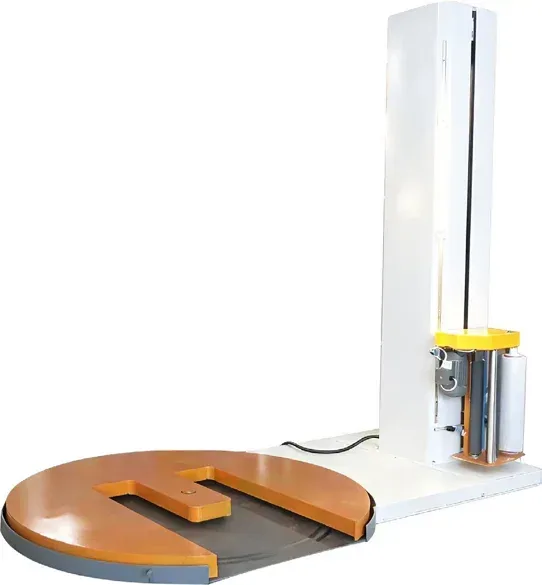
A turntable rotates the pallet past the film carriage. A rotating arm carries the film around a pallet that stays in place during wrapping. That difference matters when the stack is tall, light or easy to disturb. It also changes how the pallet enters the station and how much room the equipment needs. Compare the two motions with your loaded pallet and your actual handling method.
When does a turntable fit?
Start with a pallet that remains stable while it is positioned and rotated. Compare its loaded mass and dimensions with the selected table rating and usable platform size. Include projecting carton corners in the measured footprint. If operators use a pallet truck, specify its approach direction and whether they can use a ramp or need an open table. Ask for the entry and exit drawings for that configuration.
When does a rotating arm help?
If a loosely stacked load moves when turned, a stationary-pallet layout is worth testing. Check the area the arm sweeps through, the tallest carton and the space needed for material handling and protective measures. For a light stack, observe whether the first film passes pull the cartons out of position. The load still experiences the pull of the film while the pallet stands still.
Compare both with the same load
Use a representative pallet and the least stable pallet you expect to process. Keep film and coverage requirements comparable. Record the time to place and remove each pallet, any carton movement and the condition of the load at the next handling point. Comparing wrapping time alone leaves out the part of the job that may need the most space or time.
A decision for two different pallets
Consider a site that ships low cases on a standard pallet most days and occasional tall mixed stacks. Start by checking whether the ordinary pallet fits the table and whether the truck can place it squarely within the usable area. Test the tall stack separately and mark any shift between layers after the first passes. If it needs a stationary-load arrangement, quote that candidate against both pallet types. This separates a restriction that affects the whole station from a restriction that applies only to one family of loads.
What should the supplier see?
Send a side photo, top-view dimensions, gross mass, finished height and loads per shift. Mark fork approach and nearby columns on a floor sketch. The stretch wrapping range shows the layout families. Use the unstable load application to specify the contact, movement and coverage you want checked in the trial.