


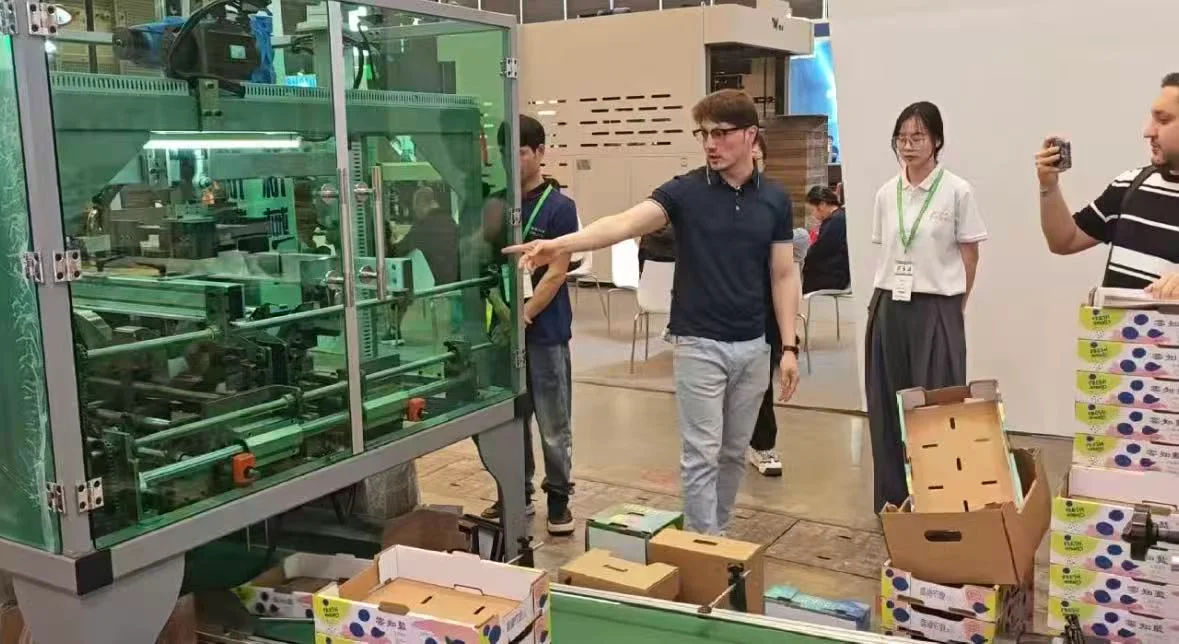
Ask three suppliers for a carton erecting machine and you can receive three different quotations: a corrugated case erector for shipping cartons, a paperboard former for fruit trays, and a lid-and-base machine for shoe boxes. All three erect a carton, but they are not the same equipment. This overview clears up the terminology, maps each box format to the right Xunding machine family, and points you to the detailed guides for the next step.
Carton erecting is a family name, not a specification
Carton erecting is an umbrella term for any machine that stands a flat blank up into a box. By itself it says nothing about the material, the box format or how the box is sealed. Two more precise terms narrow the picture: carton forming usually describes paperboard machines that fold and glue retail packaging such as fruit trays, mailer boxes and shoe boxes; a case erector describes a corrugated shipping-carton machine that opens a knocked-down case, folds the bottom flaps and seals them, usually with tape or hot melt.
The term you write in an enquiry changes what you are offered. Lead with your box — a photograph, a flat drawing and the board — rather than with a machine label, and the correct family becomes clear before anyone quotes a price.
Two machine families, two different jobs
Paperboard carton forming machines handle thinner folding-carton board and produce the product-facing boxes a customer opens: fruit and vegetable trays, mailer boxes, hinged-lid shoe boxes and lid-and-base boxes. The Xunding forming range sits here, from single-blank trays to three-piece boxes, mailer boxes and shoe boxes.
Carton erecting and sealing machines handle the shipping-carton end of the line. XD-KX450 opens and erects empty shipping cartons, while XD-FX5050 and XDZG5050 tape-seal assembled or flap-folded cartons. These are different stages of a packing line from a paperboard tray former, and they are listed separately in the catalogue.
Name the job, not just the machine
The same phrase — carton erecting machine — points to different equipment because buyers use it for different jobs. A fruit packer sending produce to Europe usually means a tray former that folds and glues open produce trays. An e-commerce brand usually means a mailer box forming machine for self-locking boxes. A footwear supplier usually means a shoe box or lid-and-base machine. A warehouse or fulfilment line usually means a case erector and a carton sealer for shipping cartons.
In each case the useful phrase is the box, not the family name. Saying fruit tray forming machine, mailer box forming machine or case erector narrows the conversation to the right equipment before the first quotation arrives. The table in the next section lists the exact phrase for each box format and where it sits in the Xunding catalogue.
The mismatch is easy to spot once you look for it. A quote for a tape-sealing machine cannot fold a shallow, glued fruit tray, and a tray former is not a case erector. Matching the phrase to the box avoids spending a quotation cycle on the wrong machine family.
See how erecting and sealing split into separate line stages
Match the family to your box format
The quickest way to find the right equipment is to start from the box you need to make. The table maps the common box formats to the Xunding range and the catalogue models that begin each discussion. Follow a model link to open its catalogue specification, then confirm the configuration against your own blank and sample.
| Box format or job | Machine family | Xunding range | Catalogue models to discuss |
|---|---|---|---|
| Fruit & vegetable trays (open, glued or locked corners) | Paperboard carton forming | Fruit tray forming machines | XD-Z03, XD-Z02, XD-Z06, XD-Z07, XD-08 |
| Three-piece fruit boxes | Paperboard forming, separate components | Three-piece fruit box machines | XD-Z04 |
| Mailer (aircraft) boxes | Paperboard carton forming | Mailer box machines | XD-09, XD-Z10, XD-Z11, XD-Z12 |
| Shoe & lid-and-base boxes | Paperboard carton forming | Shoe & lid-and-base box machines | XD-Z13, XD-Z14 |
| Shipping cartons — erecting | Carton erecting | Carton erecting machines | XD-KX450 |
| Shipping cartons — sealing | Carton sealing | Carton sealing machines | XD-FX5050, XDZG5050 |
What drives the machine: the blank, the board and the seal
Within the paperboard family, the blank is the real specification. Its crease lines, corners and joints determine the folding tooling and the glue positions. The catalogue lists board thickness in millimetres rather than one universal range: XD-Z03 and XD-Z02 list 1.5–5 mm, XD-Z06 and XD-08 list up to 7 mm, and the mailer and shoe-box models list 1.5–3 mm. Carton erecting and sealing models do not list a board thickness in the catalogue. A coated or printed board also changes how sheets separate and crease, so send the production material rather than a substitute.
Sealing divides the two families again. Paperboard boxes are usually glued with cold water-based glue or hot melt, while shipping cartons are usually tape-sealed. The gluing and taping guides below explain how to specify each one.
The forming stages matter as much as the board. The catalogue describes different feeding and gluing arrangements across models: vacuum-suction feeding on XD-Z02 and XD-Z06, bottom-suction feeding on XD-Z03, mechanical feeding on XD-08, and hot-melt gluing on XD-08, XD-Z13 and XD-Z14. These are catalogue descriptions, not a promise that every board works unchanged; the actual setup is reviewed against your blank.
Start from your box, then use the detailed guides
A terminology overview is only the first step. Once you can name your box format, move to the guide that matches your production question: selection compares box structures and catalogue candidates; gluing works through joints; taping separates erecting from sealing; folder-gluer covers corrugated board; printing places forming inside a printed-packaging process; and buying covers price and quotation scope.
Prepare the formed-box photo, flat blank drawing, board thickness and daily output. Those four details move a broad category question to a model and configuration discussion with Jason Chen.
If you are still unsure which box format to name, send the formed-box photo and the flat blank first. A clear photograph of the finished box and of the material entering the machine is usually enough for Xunding to identify the family and the likely models, before any specification is discussed.
Carton box folding machine selection
Corrugated forming vs folder-gluer
Catalogue models to discuss
These models are starting points for an enquiry. Confirm the configuration against your blank and sample.
- XD-Z03 · Multifunctional box folding machine
An automatic fruit-box forming setup combining bottom-suction feeding, folding knives, gluing, conveying and stacking.
- XD-Z04 · Three-piece fruit box forming machine
Forms three-piece fruit and vegetable boxes from separate cardboard parts, with automatic feeding and touchscreen mould settings.
- XD-09 · Automatic mailer box forming machine
Automatic forming for folding mailer boxes, described as aircraft boxes in the catalogue, for clothing, crafts, electronics and general product packaging.
- XD-Z13 · Automatic hinged-lid shoe box machine
Forms cardboard boxes with an integrated hinged lid for footwear, clothing and general product packaging, using hot-melt glue and automatic folding.
- XD-KX450 · Automatic carton erecting machine
Automatic opening and erecting equipment for shipping cartons. Confirm the carton blank and tape-sealing requirements for your packing line.
- XDZG5050 · Automatic flap-folding carton sealer
Automatically folds carton flaps and seals shipping cartons with tape. The catalogue lists standard-carton output and adjustable table height.