


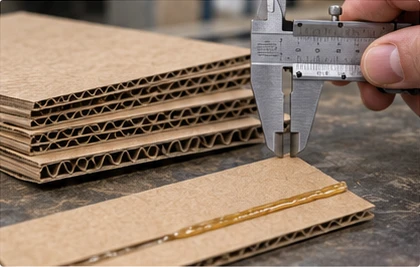
If you buy finished boxes, the converter worries about board and glue. If you buy the machine and supply your own board, that responsibility moves to you. This guide covers which board and adhesive points to agree with the machine supplier before you order — and how to record them.
Why board and adhesive specs belong in the machine order
A box forming machine does not run "boxes". It runs a specific board, folded along specific creases, held together by a specific adhesive. Change any one of those three and the same machine behaves differently — sometimes slightly, sometimes enough to stop the line.
This is the reverse of buying boxes: when a converter sells you boxes, the material risk sits on their side of the contract. When you buy a forming machine and feed it your own board and glue, the supplier can only be responsible for the machine, not the material. Draw that boundary in writing before the order.
The practical way is to make the board and adhesive specification part of the machine order itself: a short, written description of the material the machine is expected to run, attached to the quotation or order confirmation. Material questions left open at ordering tend to resurface at the trial, as forming problems nobody can attribute cleanly to the machine or the board. Agree the material first, then check the machine against it.
Board properties that affect machine running
You do not need to become a paperboard engineer. You need to know which properties matter to the machine, and to get each of them confirmed in writing against the machine specification. Check these points with your supplier:
For every item, the action is the same: record the property, ask the supplier to confirm the machine runs it, and keep the answer in the order file. If a property cannot be confirmed from the specification sheet, ask for the machine to be trialled with your actual board — the next-best evidence.
| Property | What to confirm |
|---|---|
| Board grade and thickness | Every forming machine has a range of board it is built to feed, crease and fold; check your board against the specification sheet for the model in question. |
| Grammage and stiffness | Heavier, stiffer board feeds and folds differently; if you run more than one board, list every one and ask whether any falls outside the working range. |
| Coating and surface | PE-coated, glossy or printed board changes how reliably sheets separate and how well adhesive bonds; say so at the quotation stage. |
| Moisture content | Board that is too dry or too damp creases and glues differently; store board consistently between the trial and production. |
| Grain or flute direction | Direction affects stiffness along the crease; it should already be marked on the approved drawing. |
Hot melt vs cold glue: which suits your line
Adhesive choice is where unspecified assumptions most often slip through. The two families suit different jobs, so settle which one your line will run before the order, not at the trial.
Ask the supplier which adhesive the machine is configured for, and whether switching later is possible — and at what cost in parts and settings. The table below sets out how the two families differ.
| Point | Hot melt | Cold glue (water-based) |
|---|---|---|
| How it sets | Sets as it cools. | Sets by absorbing into the board under pressure. |
| Best suited to | Fast-paced lines that need an immediate bond. | Buyers who prefer a cleaner working environment and simpler equipment. |
| Equipment implications | A heated tank with consistent temperature management. | Simpler equipment, with the bond developing under pressure. |
Open time, glue lines and adhesive supply
Open time and machine speed must match. Open time is how long the adhesive stays workable after application. If the glue sets before the flaps are pressed, the seam fails; if it sets too slowly for the machine pace, boxes leave the press weak. Do not assume any adhesive works at any speed — ask the supplier to confirm the pairing, including for any slower or faster box types you plan to run.
Glue line position, width and no-glue zones. Where the glue goes is not a detail — it is part of the box design. Check that the glue lines are marked on the approved drawing, agree their position and width, and mark any areas that must stay glue-free (near food contact, printed panels, folding seams). A glue line that drifts a few millimetres can glue a flap shut or leave an open corner.
Who supplies the adhesive. If you supply your own glue, say so at the quotation stage and give the supplier its specification, so the glue system can be checked against it. If the supplier recommends or supplies the adhesive, record which product was used at the trial so production can use the same one.
See what to inspect when material problems surface at the output end
Pair adhesive behaviour with output and changeover verification
How to record the specification
Turn the above into a one-page material specification, and make it a document both sides sign off. For each material you will run, record:
Then hold one rule: the material used at the machine trial must be the material used in production. A trial on the supplier sample board proves the machine runs their board, not yours. Bring or ship your actual production board and glue to the trial, and keep a retained sample of both with the order file.
| Item | Detail |
|---|---|
| Board | Grade, grammage, thickness, coating and direction, exactly as confirmed by the supplier. |
| Adhesive | Type, product and supplier. |
| Glue lines | Positions and any no-glue zones, referenced to the drawing version. |
| Trial statement | A statement that the machine was quoted and will be trialled against these materials. |
FAQ: can the machine run my existing board?
Can I just check the board thickness and be done?
No. Thickness is one property among several. Coating, moisture, stiffness and direction can each push a nominally "correct" thickness outside the machine working range. The only reliable check is to give the supplier your board full specification — better still, physical samples of the board and a finished box — and ask for written confirmation.
What if I run several different boards?
List them all at the quotation stage. A machine quoted for one board may need different settings or parts for another, and knowing that before the order is far cheaper than discovering it after delivery.
Your next step: collect physical samples of the board you intend to run, plus one folded box made from it, and send them with the drawing revision number. Ask for written confirmation that the machine under discussion runs that board and glue combination.