


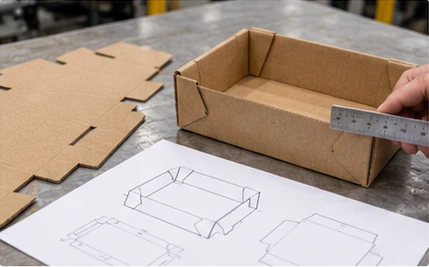
A box drawing and an approved sample are the two inputs your machine supplier builds everything else on — the quotation, the tooling and the trial. If they are vague, every later step inherits the vagueness. This guide lists what to check on the drawing, how to approve the sample, and what to record before you place the order.
Why the drawing and sample come before the machine
Most of the disagreements that surface during a machine trial — a box that measures differently than expected, flaps that sit wrong, a forming problem nobody predicted — trace back to an input that was never pinned down at the start. The drawing and the sample are how you pin it down.
A quotation given without a drawing is only a rough estimate. Once the supplier has a proper dieline, they can check whether the box falls inside the machine forming envelope, whether the creases match the folding sequence, and whether any feature needs special tooling.
Treat the drawing and sample as the first technical documents of the project, not paperwork that follows the order.
Prepare a box photos and dimensions brief before requesting a quote
What a complete box drawing should show
Before you approve a drawing, check that it contains what a machine supplier needs:
If any of these are missing, ask for the drawing to be updated before you approve it. Approving an incomplete drawing locks ambiguity into the whole project.
| Drawing element | What to check |
|---|---|
| Version or revision code | Numbered revisions so later conversations reference one unambiguous document, not a file named "final-final-v2". |
| Dimensions | Internal, external and unfolded dimensions, clearly separated and labelled so the three sets cannot be mixed up. |
| Panels, flaps and creases | Panels, flaps, slots and crease lines shown on the flat dieline, with folding direction marked. |
| Board grain or flute direction | Feeding, creasing and box stiffness all change with direction; if the drawing is silent on it, ask. |
| Loading or infeed direction | Two boxes with identical geometry but opposite feed direction can need different setups. |
| Tolerances | Tolerance values shown where they matter, confirmed in writing rather than assumed. |
How to review and approve the sample
The physical sample is where the drawing meets reality. Review it in two passes.
First, check the sample flat. Lay the blank on a plain surface and compare it against the drawing panel by panel: panel sizes, flap shapes, slot positions, crease placement. Check that creases are creased, not cut, and that cuts are clean. Mark anything that differs directly on the sample with a pen — do not trust yourself to remember later.
Second, check the sample folded. Fold it up by hand into the finished box and check squareness, flap closure, and the fit of any lid or locking corners. A sample can look correct flat and still fight you folded.
When the sample passes both checks and you are satisfied, it becomes the approved sample — often called a golden sample. The term means something specific: a physical box that both you and the supplier have examined, marked and kept as the reference standard, against which all later machine trials and production are judged. The golden sample is the baseline that finished-box quality checks refer back to, and it stays useful long after the machine is commissioned.
Sign or initial the sample itself, or its packaging, so the approval is physically attached to the object.
See how the approved sample anchors finished-box quality checks
What to record before ordering
Approval that is not recorded does not exist. Before you place the order, build a small file:
This file costs minutes to assemble. Skipping it is what turns a later "that is not what I asked for" into a long, evidence-free argument.
| Record | Detail |
|---|---|
| Approved drawing version | The revision number you approved, saved as the reference copy. |
| Marked golden samples | Two marked copies — one kept by each side — so the supplier can run machine trials against it. |
| Annotated photographs | Flat, folded and close-up photographs of the creases, glue flaps and any feature you specifically agreed. |
| Written confirmation | An email or quotation statement naming which drawing version and sample the machine will be built and tested against. |
Carry these records into the documentation and acceptance terms
FAQ: hand-folded sample vs. machine-made sample
If I approve a hand-folded sample, does that guarantee the machine makes the same box?
No, and it is not supposed to. A hand-folded or converter-made sample confirms the geometry: the panel layout, the creases, the fold logic. Machine-made samples from the trial confirm the running: how that geometry behaves at production speed. The golden sample defines what a correct box looks like; the machine trial is then checked against it. Two different checks, both necessary.
Should I approve a sample before or after I choose the supplier?
Approve the box before you order the machine — the approved sample defines what the supplier quotes against. If you switch suppliers, carry the drawing and sample forward and have the new supplier confirm them in writing.
Your next step: take clear photographs of your box sample — flat, folded, and with a dimension callout on each side — and send them with your drawing attached. Ask for written confirmation of which drawing revision and sample the quotation covers.