


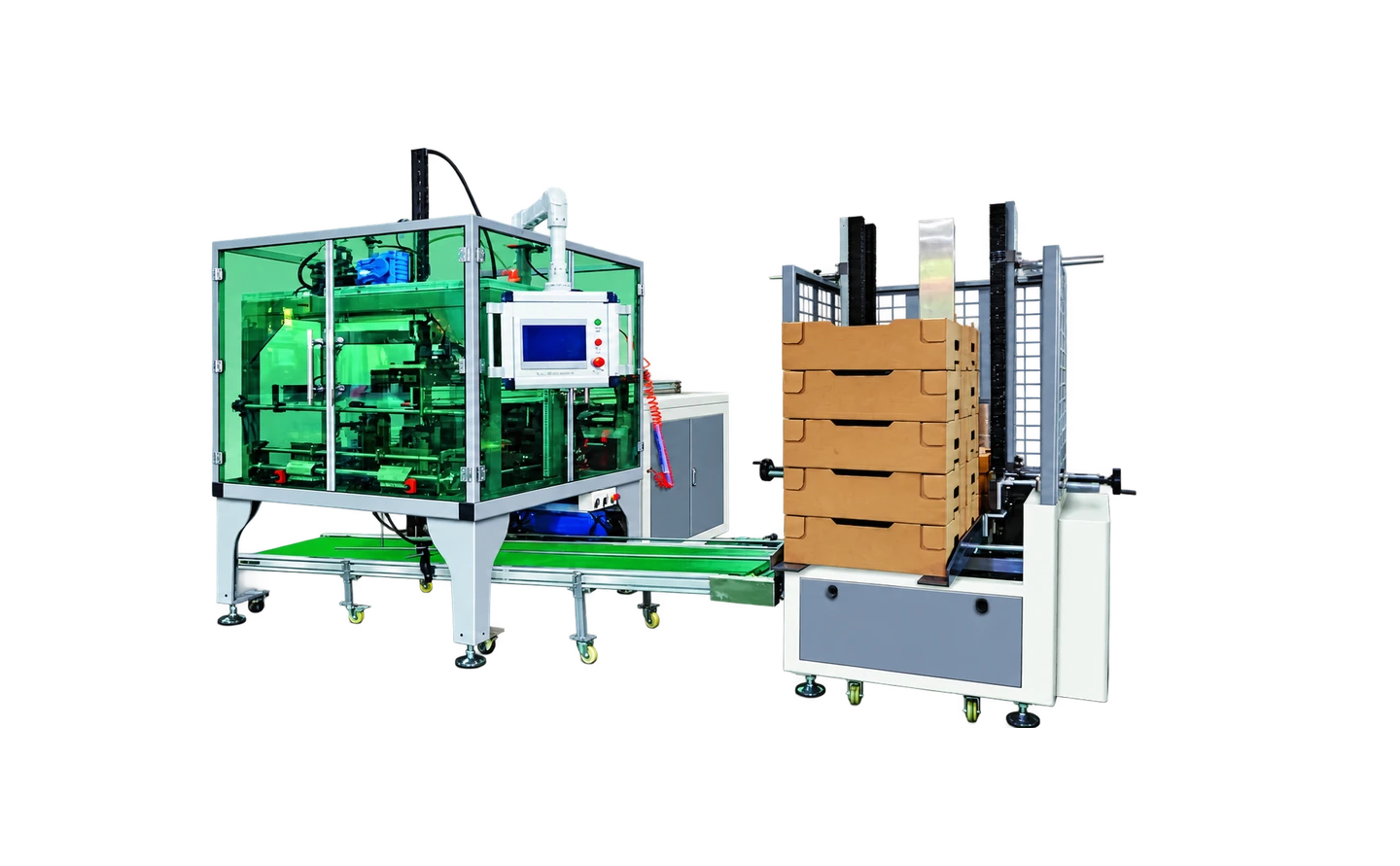
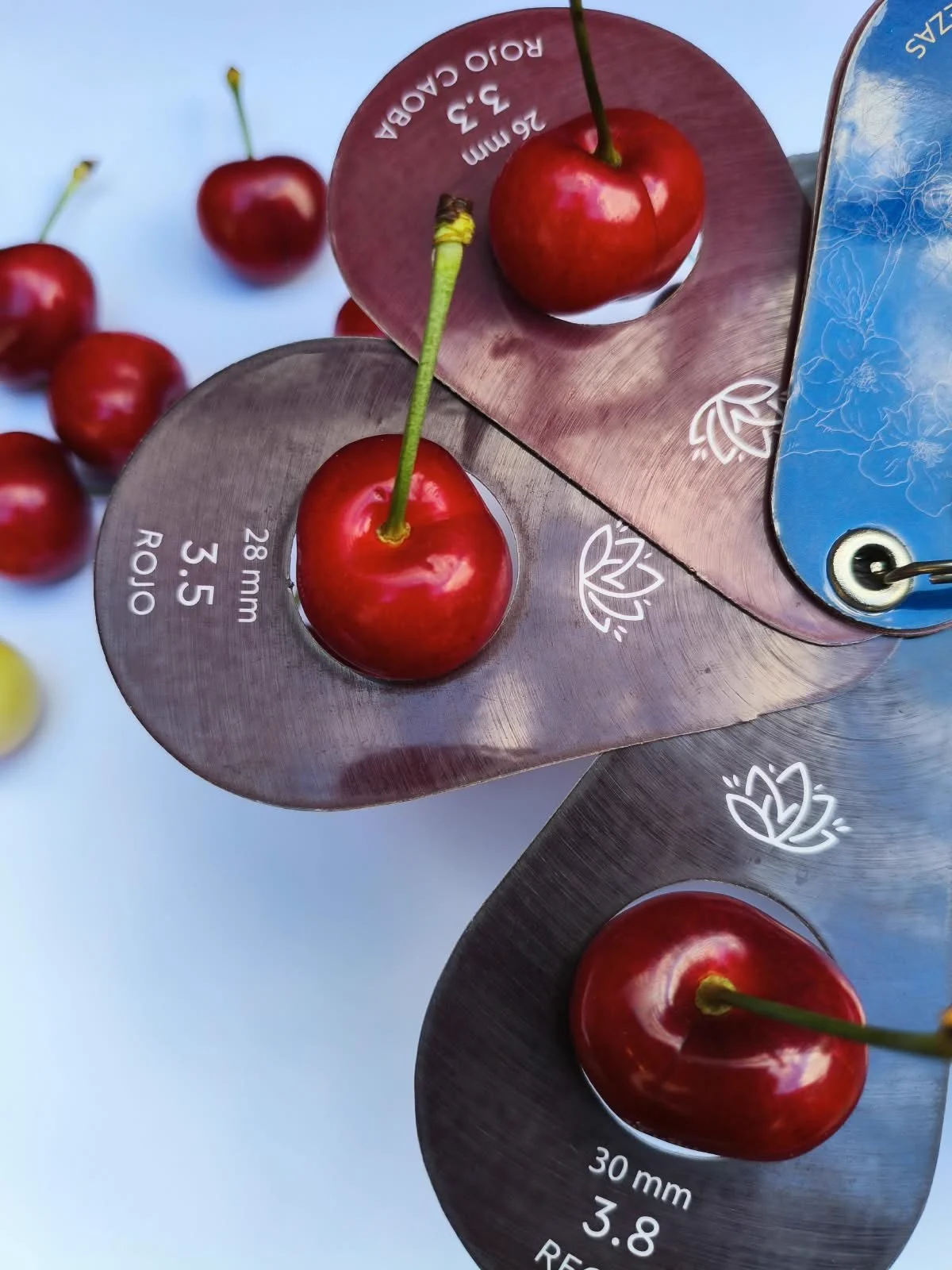
Two growers pick the same variety from the same valley in the same week. Both measure brix before harvest. Both sort to the same calibers. Both ship to the same market, in boxes of the same size and the same board grade. One arrives with stems still green after four weeks in transit; the other arrives with brown stems and soft shoulders. Nothing in the orchard explains the difference. The difference is the number of hours between the tree and the cold store — and the machine that decides those hours is usually not the sorter or the pre-cooler, but the machine that makes the boxes.
Quality is decided in the field. Freshness is decided after it.
A cherry is not a banana. It does not ripen after harvest; it only declines. Once the fruit is picked, everything that happens to it is a subtraction: sugar stays where it is, acid stays where it is, and firmness, stem colour, skin finish and shelf life all move in one direction.
That has an uncomfortable consequence for growers who have spent years improving quality. Variety choice, covers, greenhouse structures, harvest timing, a camera-based sorting line — all of it raises the ceiling of what the fruit can be. None of it survives a long wait at ambient temperature. Post-harvest quality is not a property of the fruit. It is a function of time and temperature, and you spend it hour by hour.
What happens to fruit while it waits
Fruit comes off the tree carrying field heat it cannot shed on its own. A cherry at 25–30 °C in the shade is respiring several times faster than the same cherry at 0 °C — as a rough rule, respiration doubles to triples with every 10 °C of warmth. Fast respiration burns sugars and acids, softens tissue, and releases moisture that the fruit cannot replace.
The visible symptoms arrive in a predictable order: stems lose their green first, then the skin dulls, then pitting appears, then decay organisms that were already on the surface find their opening. None of it is reversible. There is no packing step, coating or box that puts firmness back.
This is why packhouse practice is built around a rule of thumb that sounds exaggerated until you have watched it happen: for sensitive stone fruit and berries, every hour of delay at ambient temperature costs roughly a day of marketable life. The exact number depends on variety, maturity and humidity, and no honest supplier will claim it is a law. But the direction is not in dispute, and neither is the fact that pre-cooling does not stop the clock — it only slows it. A forced-air tunnel needs several hours to pull a pallet of cherries down to 0–1 °C, and those hours are spent on whatever the fruit already lost.
The queue nobody measures
Ask a packhouse manager where the time goes and you will hear about the grading line, the tunnel schedule and the truck. Almost nobody answers with the real answer: the queue.
Bins wait to be tipped. Fruit waits for a grader slot. Pallets wait for a box. Trucks wait for a full load. In a well-run packhouse each of those waits is short. In an average one, they add up to hours, and no single person owns the total.
The box is the most overlooked gate in that chain, because it sits upstream of the packers. A packer cannot pack fruit into a box that does not exist yet. When boxes run short, the line either stops — expensive — or keeps going and stacks graded fruit back into bins, waiting for boxes that will arrive in an hour. That second option is the quiet killer: the fruit is already packed in the grower’s mind, but on the floor it is sitting in a bin at 24 °C, and the clock has not stopped.
The arithmetic of hand-formed boxes
Here is where speed stops being a comfort feature and becomes a cold-chain variable. Take a mid-sized cherry operation packing 20 tonnes a day into 2.5 kg boxes: 8,000 boxes, every day, for six to eight weeks.
A skilled worker hand-forming lock-bottom trays produces roughly 100–150 an hour. Gluing by hand with a hot-melt gun is slower — 40–60 an hour — and the bond is never as consistent. So the supply side of the equation looks like this, and two things follow from it. First, matching a modern packing line with hand-formed boxes requires a crew the size of the packhouse itself, present at the same hour the fruit arrives. Second, the alternative most operations choose is pre-forming: making boxes in the afternoon for tomorrow’s fruit, or running a night shift on box making.
| Requirement | Hand-formed, lock bottom | Hand-formed, glue gun | Z-03 at 30 boxes/min | Z-03 at 45 boxes/min |
|---|---|---|---|---|
| Boxes per hour, nominal | 100–150 per person | 40–60 per person | 1,800 | 2,700 |
| Boxes per hour, realistic (65–80% of nominal) | — | — | 1,200–1,450 | 1,750–2,050 |
| People needed to supply 1,500 boxes/h | 10–15 | 25–35 | 1 operator | 1 operator |
Pre-forming is a loan against tomorrow
Pre-forming solves the symptom and hides three costs.
Floor space. 8,000 formed trays stacked twelve high is about 670 stacks, and each stack needs roughly the footprint of the box itself — in practice, 70 to 90 m² of floor that a packhouse does not have free during peak. That floor is usually the same floor the fruit needs.
Box strength. Corrugated board loses compression strength as it takes up moisture, and a packhouse in harvest season is a humid place. A formed box that sits for a day before it is filled, then goes into a cold room at 90–95% relative humidity, is not the box the board grade promised. Hand-formed lock trays compound this: corner geometry varies between workers, and a corner that is not fully locked opens in the tunnel or collapses under stacking.
Format risk. You form boxes before you know which calibers the day will produce. On a day when the caliber split shifts, the pre-formed stock is the wrong box, and someone starts hand-forming the right one anyway. There is also a slower cost that never appears on a balance sheet: pre-formed boxes are made by people who could be grading fruit, in a building where every square metre is contested.
What 20 to 50 boxes a minute actually buys
The number on a specification sheet is nominal output — the machine’s rate with a clean feed, a steady board and an operator who is not clearing a jam. On a real floor, effective output runs at 65–80% of nominal depending on board thickness, box size, glue pattern and how often formats change. That still changes the picture, because the machine covers the pack line rather than trailing it.
Read the two tables together and the sizing rule becomes obvious: a machine running 30 boxes a minute with realistic efficiency covers a 4 t/h line with margin, and a 6 t/h line needs the upper end of the range — 45 to 50 a minute sustained — or a second forming position. Sizing above that is capital sitting still; sizing below it puts you back in the queue. The operational consequence is the point of the whole exercise: when box supply exceeds pack rate, you stop pre-forming. Boxes are made on demand, an hour ahead of the fruit, and the packhouse runs on the harvest’s schedule instead of the box stock’s.
| Pack line output | Boxes needed per hour (2.5 kg) | Boxes needed per hour (5 kg) |
|---|---|---|
| 2 t/h | 800 | 400 |
| 4 t/h | 1,600 | 800 |
| 6 t/h | 2,400 | 1,200 |
Speed is only worth having if every box is right
A jam costs ten to thirty minutes and a supervisor’s temper. Glue in the wrong place costs a pallet: a box that opens in the tunnel, crushes under stacking, or blocks airflow because its vents no longer line up.
That is the honest argument against buying speed alone. At 45 boxes a minute, the window in which the glue must land in the right place is measured in milliseconds, and a machine that gains speed by loosening its positioning tolerance is not faster — it is just producing rejects faster. This is where the configuration matters more than the headline rate.
The Z-03 is built around that problem. Its control architecture is a Siemens motion controller with four servo axes on absolute encoders, so axis positions are known at power-up and the fold sequence stays synchronised at every speed rather than only at the speed it was tuned for. Glue placement is guided by fibre-optic positioning with servo-driven front and rear application, which removes the dependence on reflected light from board colour and print — the classic source of glue drift when a machine runs faster than the sample it was set up on. The Valco hot-melt unit compensates automatically as tank level and temperature move over a long shift. And the bottom-draw vacuum feed picks one blank at a time, which matters because double feeds, not slow cycles, are what actually stop a forming machine.
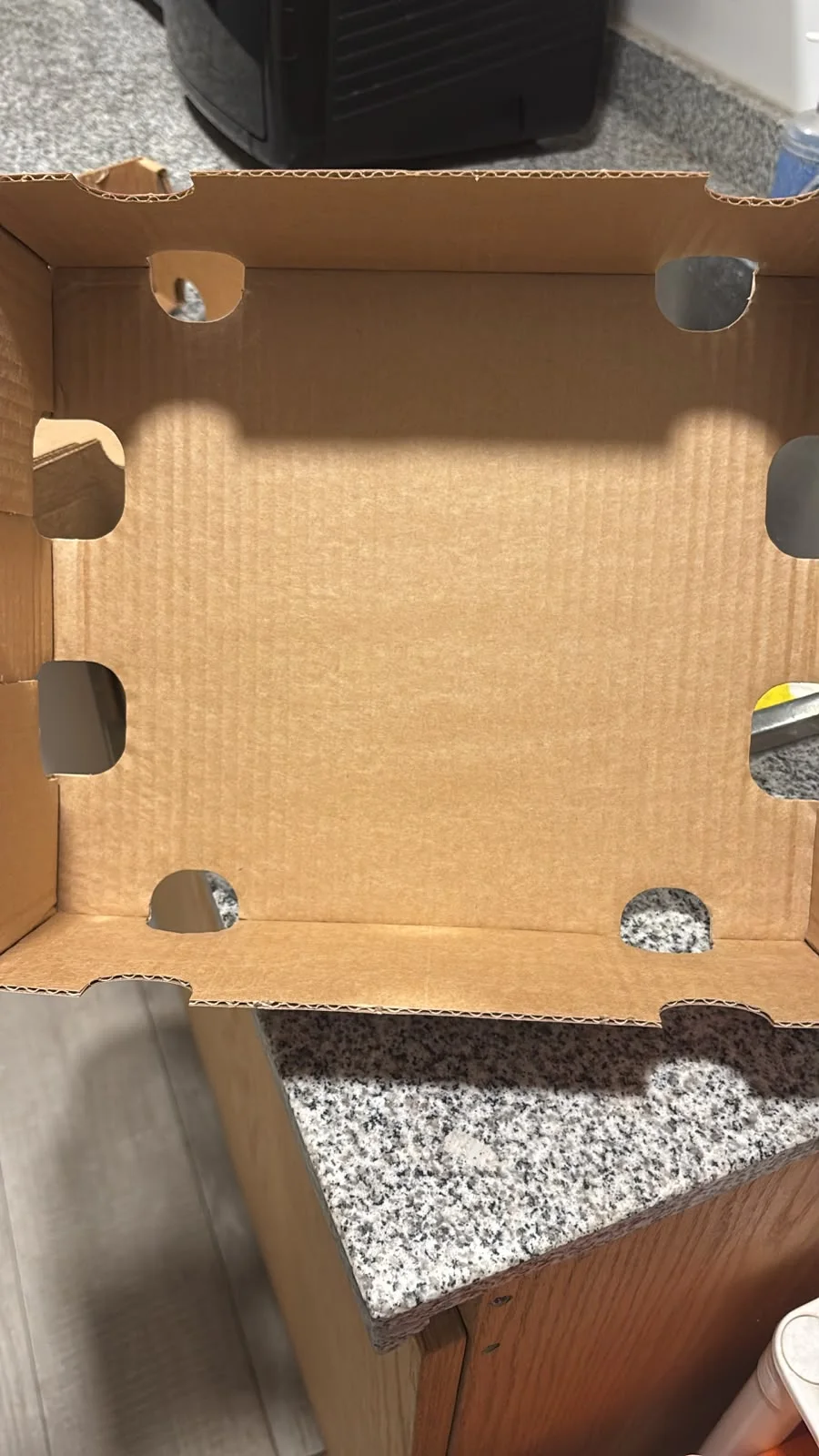
The size envelope matters for the same reason: 2.5 to 7 mm board, blanks from 370 to 1000 mm by 500 to 1100 mm, and boxes from 180 to 650 mm long, 180 to 470 mm wide and 50 to 250 mm high. That covers a 2.5 kg cherry tray, a 5 kg apple or avocado box and most of the vented stone-fruit formats in between — which means one machine can serve a mixed programme instead of one format per machine.
| Configuration element | What it protects when the rate goes up |
|---|---|
| Motion controller + 4 servo axes, absolute encoders | Fold sequence stays synchronised at every speed; no re-homing after a stop |
| Fibre-optic positioning, servo front/rear gluing | Glue line lands in the same place regardless of board colour or print |
| Hot-melt unit with automatic glue compensation | Consistent bead over an eight-hour run as the tank drains and heats |
| Bottom-draw vacuum feed | One blank per cycle — the main cause of jams is eliminated rather than managed |
| Continuous feed, form, convey, stack | Boxes leave formed and counted; no manual handling between stations |
| Quick mould change | Format switch in minutes when the caliber split changes mid-day |
| Automatic fault diagnosis | A jam is cleared in minutes by the operator, not hours by a technician |
| Infrared safety protection | An operator can work close to a fast machine without being exposed to it |
A cold-chain timeline, with and without
Numbers make the argument better than adjectives. Assume 20 tonnes a day of cherries into 2.5 kg boxes, fruit arriving from the orchard from 07:00, ambient 26 °C, a pack line rated at 1,500 boxes an hour, and a forced-air tunnel that needs six hours once a pallet is loaded.
Read the last column of the last row carefully. Nobody is claiming a machine makes fruit better. The claim is narrower and harder to argue with: the fruit is exposed to warm air for roughly half as long, and the same fruit, cooled sooner, arrives with more of what the orchard produced.
There is a second-order effect worth knowing. Uniform boxes cool predictably. Machine-formed trays hold their corners and their vent alignment, so air moves through the pallet the way the tunnel design assumes. Hand-formed boxes with crushed corners create bypass channels — the air takes the easy path, the centre of the pallet stays warm, and the tunnel takes longer for fruit that was already late.
| Step | Hand-formed, pre-made stock | Hand-forming at the line | Boxes formed on demand |
|---|---|---|---|
| Box supply at peak | Capped by the pre-forming shift | 500–600 boxes/h, less when a worker is pulled away | 1,200–1,450 boxes/h |
| Effective pack rate | 600–900 boxes/h | 500–600 boxes/h | At the line’s own rate |
| Fruit waiting in bins, mid-morning | 3–5 tonnes | 5–8 tonnes | Under 1 tonne |
| Average hours, harvest to tunnel | 7–9 | 9–11 | 4–5 |
| Practical effect on grade | Stems acceptable, some softening on the earliest fruit | Highest proportion of soft fruit and stem browning | Fruit reaches the tunnel within the same shift it was picked |
Size the machine to the line, then run it below maximum
A forming machine is not a race car, and the fastest setting is rarely the right one. The method that works starts with the peak hourly consumption for each box format rather than the daily average, because peaks are what stop lines. Add 20–25% as the design margin, then check the resulting rate is inside the machine’s range for your board and box size.
Hold 20 to 30 minutes of buffer — roughly one pallet of boxes: enough to absorb a format change, not enough to become pre-forming again. Run at the line’s rate instead of the machine’s ceiling; a former running at 80% of maximum all day produces more usable boxes than one sprinting at 100% and stopping twice an hour. Change formats with the mould rather than with stock, because quick mould change exists so you do not have to guess tomorrow’s caliber split today.
Then track two numbers: boxes per jam, and glue rejects per thousand. If either climbs when you raise the rate, the rate is wrong, not the operator.
What the hours are worth
Illustration only, because every operation’s numbers differ: 20 tonnes a day at a wholesale value of USD 4 per kilogram is USD 80,000 of fruit moving through the building every day. A one percent shift between premium and standard grade — the kind of shift that stem colour and firmness decide — is USD 800 a day, or about USD 48,000 across a sixty-day season. You can run the same sum with your own price differential and your own rejection rate; the conclusion usually holds, and it usually holds by a wide margin against the capital cost of a forming machine.
The mistake is to compare the machine’s price against a box’s price. The comparison that decides the investment is the machine’s price against the value of arriving one grade higher, on every pallet, for the whole season.
Frequently asked questions
Does running the machine faster produce weaker boxes?
Not if the glue is placed correctly. Box strength comes from board grade, fold geometry and a continuous glue bead — none of which depend on cycle speed. What does depend on speed is positioning accuracy, which is why the configuration matters more than the rate. A machine that holds glue position at 45 boxes a minute produces boxes identical to the ones it makes at 20; a machine that drifts at 45 should be run at 30 until it is fixed.
Can one machine keep up with a 5 tonne per hour line?
At 2.5 kg per box, 5 t/h needs 2,000 boxes an hour. That is inside the range of this configuration at the upper end, in 3–4 mm board, with a steady feed — and it is why a sample trial on your own board and blank is the only honest way to confirm the rate. At 5 kg per box the same line needs 1,000 boxes an hour, which leaves comfortable margin.
What board and box sizes can the machine form?
Board from 2.5 to 7 mm, blanks from 370 × 500 mm up to 1000 × 1100 mm, finished boxes from 180 to 650 mm long, 180 to 470 mm wide and 50 to 250 mm high. That spans 2.5 kg cherry trays, 5 kg top-fruit boxes and most vented stone-fruit formats.
We already pre-form boxes overnight. Is that not cheaper?
It is cheaper per box until you count the night shift, the floor space, the boxes that deform before they are filled, and the formats you formed for a caliber split that did not happen. Pre-forming is a working-capital loan you take out every day of the season.
Four questions come up in almost every conversation about box-forming speed and the cold chain.
If the bottleneck is measured in hours, start here
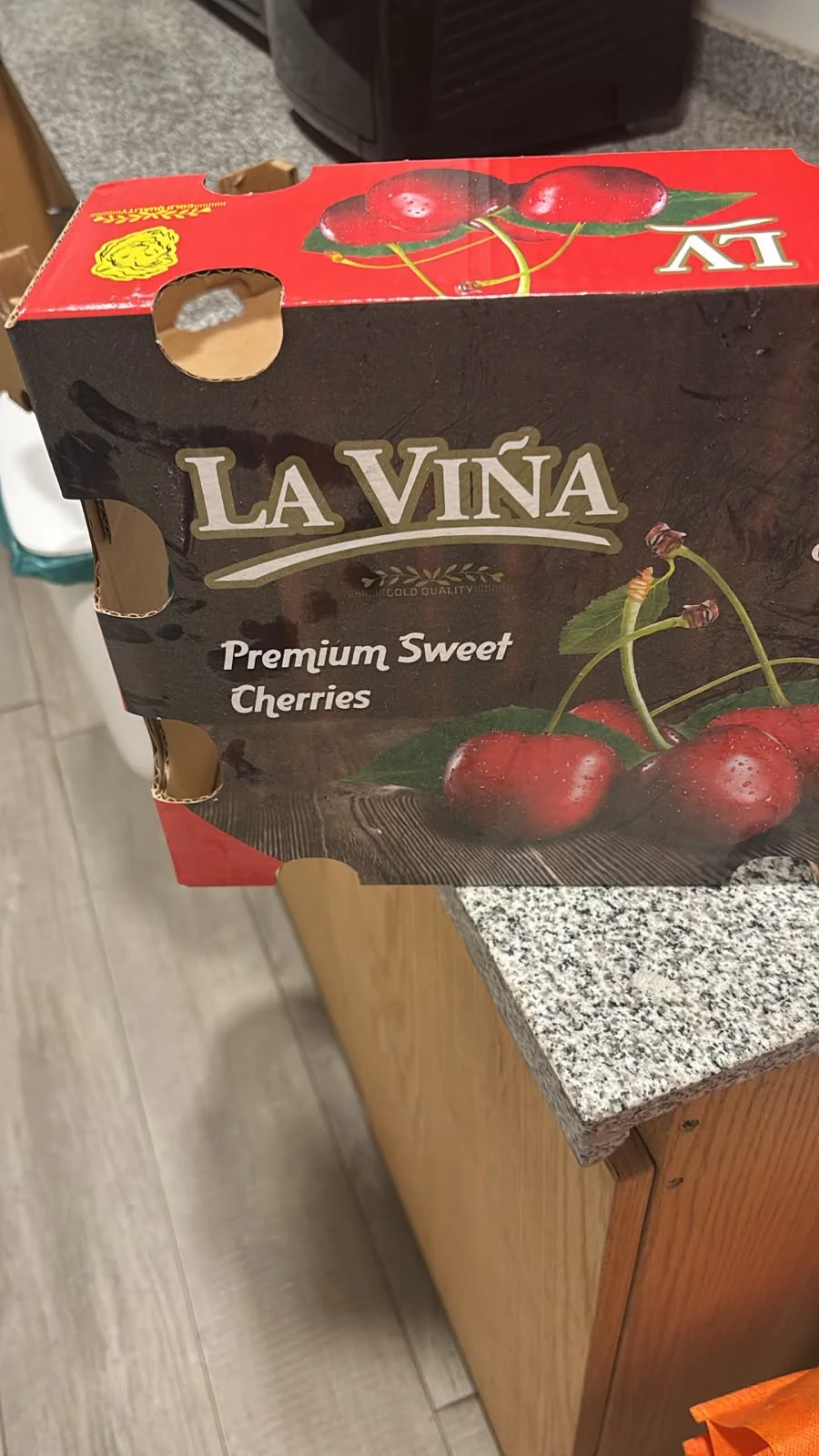
Send us three things and we can tell you, with numbers rather than adjectives, whether box supply is your constraint: the peak hourly box demand for each format, the dieline or a photo of the box with its dimensions, and the board grade you actually buy. If the answer is that a forming machine would remove hours from your cold chain, a sample trial on your own board settles the rate question in an afternoon.
The fruit will not be fresher because of a machine. It will be fresher because it waited less — and that is a decision about throughput, made before the season, not during it.
Catalogue models to discuss
These models are starting points for an enquiry. Confirm the configuration against your blank and sample.
- XD-Z03 · Multifunctional box folding machine
An automatic fruit-box forming setup combining bottom-suction feeding, folding knives, gluing, conveying and stacking.